 Official Government Website
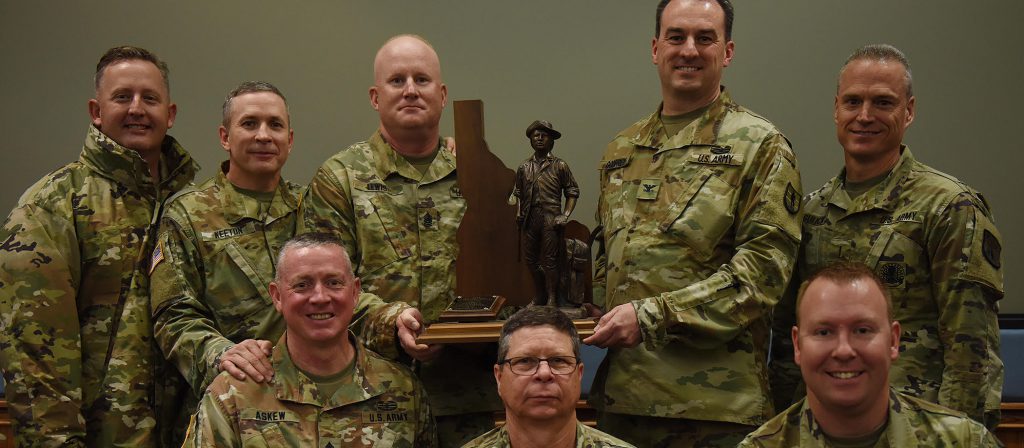
The 204th RTI claims the Idaho Governor’s Outstanding Unit Award
 05.17.2019
Story by Master Sgt. Becky Vanshur
Idaho Governor Brad Little, along with Idaho Adjutant General Maj. Gen. Michael Garshak, recognized the Idaho National Guard’s top unit and several exceptional individuals in a ceremony on Gowen Field, May 17.
Little and Garshak presented the Governor’s Outstanding Unit Award to the Idaho Army National Guard’s 204th Regional Training Institute Regiment.
The regiment was recognized for aggressively directing efforts across three primary focuses of strength management, accreditation visits and supporting the 116th Cavalry Brigade Combat Team.
Additionally, the governor and Garshak presented the Idaho Distinguished Service Medal to Cheryl Miller and Cynthia Krapff, and the Idaho Meritorious Service Award to Ric Johnston and retired Chaplian Thomas Westall for their years of valuable service to the Idaho Military Division.
“This is a great opportunity to be able to recognize the impressive units we have here in the Idaho National Guard, as well as several individuals who have made notable contributions to our Soldiers, Airmen, our families and the mission,” said Garshak. “It’s always a great honor to have the governor, our commander in chief, here to make these significant presentations.”
Back to Newsroom
JOIN the Idaho Army National Guard
05.17.2019
Story by Master Sgt. Becky Vanshur
Idaho Governor Brad Little, along with Idaho Adjutant General Maj. Gen. Michael Garshak, recognized the Idaho National Guard’s top unit and several exceptional individuals in a ceremony on Gowen Field, May 17.
Little and Garshak presented the Governor’s Outstanding Unit Award to the Idaho Army National Guard’s 204th Regional Training Institute Regiment.
The regiment was recognized for aggressively directing efforts across three primary focuses of strength management, accreditation visits and supporting the 116th Cavalry Brigade Combat Team.
Additionally, the governor and Garshak presented the Idaho Distinguished Service Medal to Cheryl Miller and Cynthia Krapff, and the Idaho Meritorious Service Award to Ric Johnston and retired Chaplian Thomas Westall for their years of valuable service to the Idaho Military Division.
“This is a great opportunity to be able to recognize the impressive units we have here in the Idaho National Guard, as well as several individuals who have made notable contributions to our Soldiers, Airmen, our families and the mission,” said Garshak. “It’s always a great honor to have the governor, our commander in chief, here to make these significant presentations.”
Back to Newsroom
JOIN the Idaho Army National Guard
Idaho Army National Guard deploys to Guatemala
Courtesy Story
Idaho Army National Guard
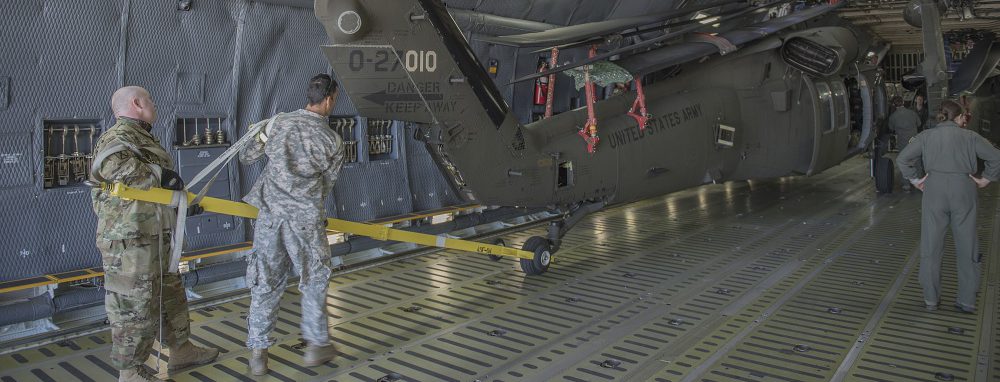
Approximately 30 Soldiers from Idaho’s 1st Battalion of the 183rd Assault Helicopter Battalion deployed to Huehuetenango, Guatemala, Sunday in support of Beyond the Horizon 2019.
These Idaho Army National Guard aviation Soldiers will spend their annual training period providing casualty evacuation support and equipment transportation for U.S. military engineers and medics as they build schools and set up medical clinics for the citizens of Guatemala from April 28 to July 27.
“This mission is an excellent opportunity for our Soldiers to deploy to a foreign country and do their jobs in an unfamiliar environment,” said Maj. Bryan Reid, the unit’s operations and training officer.
Nearly 150 pilots, crew chiefs, mechanics, petroleum specialists, signal specialists and supply personnel from the 1-183rd Assault Helicopter Battalion will rotate through Guatemala in two-week rotations.
“It is really exciting to get an opportunity to fly helicopters in a foreign country,” said 1st Lt. Colton Ankeney, the Beyond the Horizon 2019 project officer. “It will provide its own challenges and experiences that you can’t get training in the States.”
Beyond the Horizon is a U.S. Southern Command-sponsored, joint foreign military humanitarian civic assistance exercise. Hundreds of Active Duty, National Guard and Reserve members from all services will participate in the annual exercise.
The mission helps build relationships with the host nation by working with its military to improve the infrastructure and medical wellness of their citizens. Idaho Army National Guard Soldiers will receive valuable training in a deployed location to maintain their individual and unit readiness.
Col. Smith takes command of the 124th FW
05.05.2019
Story by Capt. Rebecca Solosabal
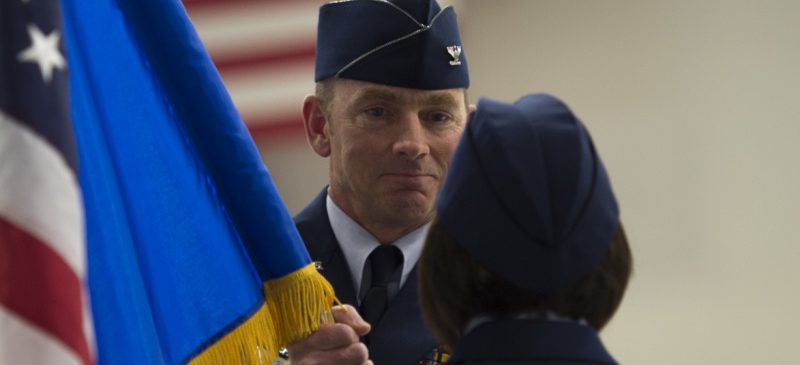
A new commander took lead of the Idaho Air National Guard’s 124th Fighter Wing during a change of command ceremony May 5, 2019, at Gowen Field, Boise, Idaho. Col. Shannon Smith accepted accountability of the wing in front of guardsmen, community leaders, family and friends.
“I am truly humbled and honored to stand here before you today, and I thank you for sharing in this moment,” said Smith, as he addressed Airmen as their new commander. “Your presence here today is witness to the service and sacrifice of our Idaho guardsmen and their families.”
Smith assumed command of the 124th FW from Col. Tim Donnellan, who had led the wing since 2015 and has been selected to serve as the Idaho ANG chief of staff within the Idaho Military Division.
Brig. Gen. Michael Nolan, assistant adjutant general–air, Idaho Air National Guard, presided over the ceremony and, with the guidon, symbolically passed leadership responsibility of the wing from Donnellan to Smith.
“Col. Donnellan, my hat’s off to you; you are a man of action and your words count,” said Smith. “My sincere gratitude for your service and your devotion to our mission and our Airmen, and I commit to uphold the standard you have so vividly set.”
With 27 years of military service, 17 of which were in Idaho, Smith comes with an abundance of command experience. Prior to his current role, Smith served as the 124th Operations Group commander, and before that as the 124th Maintenance Group commander. He also previously deployed to Operation ENDURING FREEDOM as deputy commander, 455th Expeditionary Operations Group, 455th Air Expeditionary Wing, Bagram Air Base, Afghanistan.
“Airmen of the 124th Fighter Wing, as you well know, we are always on mission,” said Smith. “This fighter wing is at the tip of the spear, and that is exactly where we belong.”
Both commanders touted the readiness and accomplishments of the wing. Donnellan highlighted the “heroic” effort of the wing’s Airmen over the last four years as they executed the largest deployment in IDANG history and strengthened community ties at home. Smith reminded the wing of Airmen who are currently deployed in various theaters throughout the world, and that readiness, partnerships and innovation would be essential to future operations already on the horizon.
As he addressed his new wing, Smith emphasized the uniqueness and importance of the Guard members as citizen Airmen. Smith said, “We are who we are by design, and we will not apologize for that. Our nation needs the Guard now more than ever.”
“I would choose no other team, at no other time than here today with you,” he said. “Go Guard! Attack!”
Diversity inclusion creates winning organizations
05.03.2019
Story by Master Sgt. Becky Vanshur
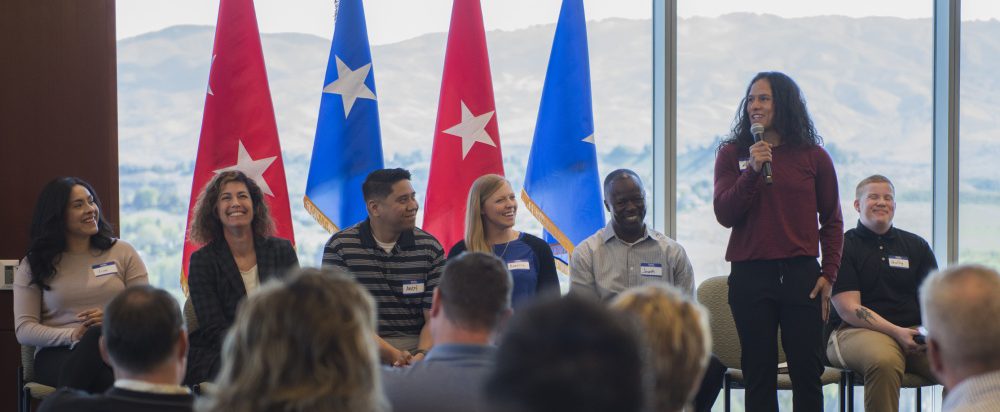
BOISE, Idaho – The Idaho National Guard hosted a Joint Diversity Executive Council conference on April 30 in Boise to address the importance of diversity inclusion in the workplace. Key military and civil leaders from 14 states, one territory and the National Guard discussed solutions for stopping discrimination in their organizations.
“An organization with diverse experiences and cultures will be a winning organization,” said Brig. Gen. Michael Nolan, Idaho’s assistant adjutant general-Air. “It’s easy for an organization to grow stale when we continue the notion that everyone is and should be thinking and acting in the same way. The whole point to diversity inclusion is for us to realize that we, as an organization, already have an internal bias, but we have to open our minds to people we may see as different from us.”
The JDEC, made up of seven regions representing each state and territory, advises the chief of the NGB and adjutant generals on diversity and inclusion matters. Regions six and seven attended the two-day conference, which included Alaska, Arizona, California, Hawaii, Idaho, Montana, Nevada, New Mexico, North Dakota, Oregon, South Dakota, Utah, Washington, Wyoming and the territory of Guam.
Day one began with a diverse panel of Idaho National Guard Soldiers and Airmen sharing the experiences that have impacted their lives or caused roadblocks in their careers.
“I moved to Idaho from down south, where I did witness discrimination, but being here has been eye-opening and breath-taking,” said Sgt. 1st Class Joseph Henry, from the 2nd of the 116th Cavalry Regiment. “Here, I am just like everyone else, I don’t get treated differently. I don’t get looked at differently because of the color of my skin.”
Sgt. 1st Class Melanie Galletti, from the 116th Cavalry Brigade Combat Team, spoke about a time in her life she felt singled out due to her race and gender in her former unit.
“While in active duty in 2000 my battalion commander had me in his office for an in-briefing,” said Galletti. “I distinctively remember him saying to me ‘now I know about you Latino females’ and then after that I didn’t hear anything else he said, because those were the only words I could focus on. I joined the Idaho Army National Guard in 2010. Have I experienced any type of discrimination here? Absolutely not, not as a female and not as a Latino female.”
In 2017 Galletti became Idaho National Guard’s first female infantry Soldier.
Throughout the conference, several themes were highlighted to help eliminate discrimination, such as emphasizing diversity and inclusion, exercising open-mindedness, embracing change and being receptive to newer generations coming through while controlling hostile work environments.
“We have to continue to train our brains and it’s not just a nationality, religion or gender issue, it’s every form of discrimination,” said Command Sgt. Maj. Becky Burkhart, Idaho’s first female command sergeant major. “We have to remember that the person next to you in the foxhole – it doesn’t matter who they are – as long as they have your back. It is up to leaders to continue this concept. Here in Idaho, I have never been treated poorly for being married to another female Soldier.”
Burkhart has been married to her wife for more than four years.
“We have to accept that some derogatory things are going to happen, people are going to say inappropriate things and it’s how we handle it that matters,” said Galletti. “We need to close the doors for the opportunity of harassment to continue, by keeping an open mind and respecting our peers. If we are going to do this, if we are going to diversify, let’s just do it all the way through in every single aspect.”
Several leaders from local businesses took part by speaking during the two-day conference. They shared their insight on diversity inclusion programs and their efforts on overcoming discrimination issues. Participants in the event were Zion’s Bank, Boise State University, College of Idaho Cultural Experience and Insight, the Idaho Youth ChalleNGe Academy, the Ballet Folkloric Mexico Lindo dancers, Idaho State Police, Boise Fire Department, the Basque Center and the Idaho State Museum forum on Native American and Indian tribes.
“Diversity and inclusion starts with our youth,” said Trevor Sparrow, director of the Idaho Youth ChalleNGe Academy. “Programs like the Idaho Youth ChalleNGe Academy start the process of opening the minds of youth to diversity and inclusion.”
Senior Airman Tanner Morales, a graduate from the Idaho Youth ChalleNGe Academy and an aerospace propulsion technician in the 124th Maintenance Squadron, spoke about what he has learned after graduating from the Idaho Youth ChalleNGe Academy.
“I don’t see people as what I am physically seeing standing in front of me, but I see them as what I can learn about them and learn from them,” said Morales. “I like the fact that I can fall back on someone that thinks differently than me. If I have a problem that needs to be solved, I may not be approaching it the right way, and having a person that has a different background than me may have a different way on how they articulate their thoughts. That to me is very valuable.”
Improving diversity inclusion is a top priority for Maj. Gen. Michael Garshak, adjutant general of Idaho and commander, Idaho National Guard.
“We need to open our thoughts, our minds and our views on diversity,” he said. “We need to recognize the strengths it can bring in directly contributing to our greatness as an organization. I continue to embrace and appreciate every opportunity to strengthen our understanding of diversity, with the hopes of improving our organization here in Idaho.”
You Got Your Go – ASOS Ranger Graduate

04.30.2019
Story by Master Sgt. Joshua Allmaras
“I think I didn’t get it,” said Master Sgt. Douglas Brock, a tactical air control party craftsman assigned to the 124th Air Support Operations Squadron in Boise, Idaho. “I didn’t get my look and this is going to have to happen all over again. I’m going to recycle.”
Brock was almost to the end of his journey to become the first graduate of ranger training in 124th ASOS history. Although there have been prior service ranger-tab-wearers in the squadron, no one has graduated directly from the unit until now.
The road to this moment for Brock wasn’t a typical one. He hadn’t thought much about ranger school, but when a fellow Airman asked if Brock wanted to put in for it, he agreed. To their surprise, they were both accepted in early 2018.
“Another Airman in my unit did the legwork and got us seats and I give him all the credit for opening this door for me,” said Brock.
Unfortunately due to a government shutdown, Brock’s seat at the school was cancelled, but his interest in becoming a ranger didn’t fade from his mind.
“I went to the NCO Academy and that’s where I thought, ‘I need to do this,’” said Brock.
He got everything lined up and ended up securing another seat. Soon, Brock departed out of Boise for Fort Benning, Georgia, home of the ranger pre-qualification courses.
“I was very anxious,” said Brock. “There were a lot of nerves and I didn’t know what to expect. I was also very excited to the point that I wasn’t eating.”
Although Brock didn’t know what to expect, when he arrived in Columbus, Georgia he quickly found out he wasn’t alone.
“We all had two to three large green duffle bags and we all had shaved heads,” said Brock. “I began to piece together that we all were going to the same place.”
In order to qualify for ranger school, hopefuls must complete a pre-ranger course. Brock chose to attend the Army’s Ranger Testing and Assessment Course where he hoped to blend in.
“I get to RTAC and there’s 120 of us who show up in PT gear,” said Brock. “I’m the only one in Air Force PT gear.”
Everyone had questions about the Air Force guy, but it didn’t faze him.
“I had all this pressure of being the oldest guy and the Air Force guy, but really everyone’s on the same playing field,” said Brock.
The two-week course was over before he knew it and Brock was ready to attempt to move forward to ranger school.
“There’s no guarantee you’ll get a slot in ranger school after RTAC,” said Brock. “I walked over to ranger school and stood in formation for hours and finally got selected to stay.”
The initial course candidates were separated into three companies, each of which complete three phases of schooling. The first phase focused on individual performance.
“The first phase is pretty cutthroat,” said Brock. “The first week is the ranger assessment phase and it’s all individual-based training. It’s not easy and I thought to myself, ‘what did I just get involved with.’”
Being the outsider wasn’t easy.
“It was a pretty painful process for me during the first three weeks,” Brock said. “I asked a lot of questions because I didn’t know the Army lingo. There was a lieutenant who took me under his wing and helped me all the way to graduation. This was the perfect example of how the Army and Air can work together.”
Ranger school isn’t easy, but there was one thing that was particularly tough for Brock.
“Motivation was the hardest part,” he said. “Despite the fact that you are completely worked over, you have no food in your system, you haven’t slept in I don’t know how many hours and you still need to operate. You still need to function. You have to find a way to not only motivate yourself, but also the rest of the guys in the company to stay focused and get the job done.”
The rigors of the course took a toll on every company member. It was more than camping and playing in the dirt with the Army.
“Every phase you have an evaluation and you get two looks during each phase,” said Brock. “You have to pass one of them to move on.”
Through the exhaustion, hunger and increased pressures of the course, one memory stood out for Brock.
“I got my first assessment in the third phase and failed it,” he said. “We were on a 10-day field training exercise and I finally got my second look on day eight. They don’t tell you right away if you pass. They wait an entire day.”
The waiting wasn’t easy. What made it more difficult was watching two of his fellow teammates receive bad news.
“Both of these guys got an hour debrief and I can see what’s going on and they are getting berated,” said Brock. “I’m thinking about it and stressing. I can feel the tears in my eyes.”
The other guys were finally done and Brock couldn’t wait any longer. Eager to hear his fate, he approached the ranger instructor.
”Let’s cut to it, did I pass?” asked Brock.
The instructor was shocked, but put his hand out to shake Brock’s and said, “You got your go.”
That simple statement from his instructor gave Brock immense relief. This moment and more motivated him during the 62-day course.
“Every day I was struggling and it was hard to put one foot in front of the other,” said Brock. “I kept thinking about April 5 and being at Victory Pond with my dad putting the tab on.”
Brock graduated as the course’s enlisted honor graduate April 5, 2019 as the first ranger to be qualified directly from the 124th ASOS.
His father pinned his tab on and his goal to become a ranger was complete. His experience culminated in words of wisdom for his fellow Airmen.
“If you truly want something bad enough, there’s truly nothing that can get in your way and stop you,” said Brock. “If you want to go do something, establish a program or plan and then make it happen. There’s no excuses. You can do it.”
ACC Commander visits IDANG
BOISE, ID, UNITED STATES
03.28.2019
Story by Airman 1st Class Mercedee Wilds
124th Fighter Wing
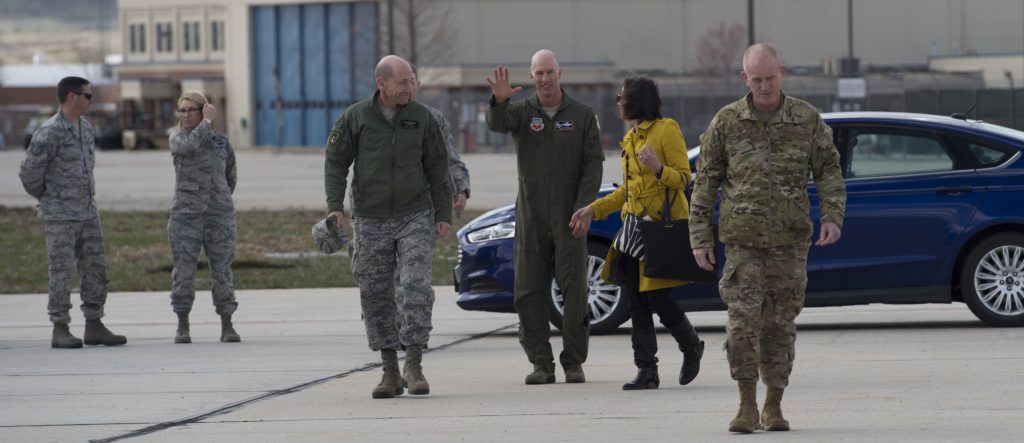
Gen. Mike Holmes, commander of Air Combat Command, visited Airmen from the Idaho Air National Guard while on a tour of multiple installations, March 28, 2019, at Gowen Field in Boise, Idaho.
Holmes said the focus of the Air National Guard aligns with his primary goals, which include revitalizing squadron readiness, developing leaders and reaching the future faster. In addition to revitalizing weapons systems, increasing the readiness of Airmen and their families is Holmes’ top priority.
When it comes to selecting leaders, Holmes looks for individuals who are ready to win in a joint mission environment, which is an area the Guard excels in.
“There is an environment in the ANG that gives Airmen the opportunity to learn, develop and take on leadership,” said Holmes.
He said a leader is someone who can guide the team they’ve been given and accomplish their mission within their resources and with the Air Force’s core values top of mind.
“The ANG does a great job of preparing and presenting leaders,” said Holmes.
Holmes said he is focusing on removing red tape and delays that stop the total force from modernizing. “My wish for everybody in the Air Force and ANGis that they find a life that gives them meaning and purpose,” said Holmes. “I hope that the time they spend wearing the uniform contributes to that.”
Back to Newsroom
Join the Idaho Air National Guard
Idaho’s first female command sergeant major encourages soldiers to manage their own careers

BOISE, ID, UNITED STATES
03.31.2019
Story by Crystal Farris
Idaho Army National Guard
Command Sgt. Maj. Linda Burkhart was born in Eureka, California, and as a 10-year-old, visited her aunt and uncle who were working for the U.S. Forest Service in Idaho. During the trip she fell in love with Idaho and decided to move there one day.
Burkhart finally moved to Idaho when she was 32 and looking for a new direction in life. She worked for the United States Postal Service, where she met two Idaho National Guardsmen. Having always wanted to wear the uniform, Burkhart enlisted into the Idaho Army National Guard one year later on Nov. 18, 1994, as a signal specialist.
“I wanted to be part of something bigger,” said Burkhart. “I was looking for that one thing that would put my life in a good direction and the Guard did that for me.”
Burkhart has served in the Idaho Army National Guard for the past 25 years and earned the Army’s highest enlisted rank in 2014, when she became the state’s first female command sergeant major.
From spending her first drill getting dirty in the field as a private, to leading troops as a company first sergeant, Burkhart said her career has been memorable and full of opportunity.
“I’d come home filthy and tired from the field but excited because I felt I achieved something,” said Burkhart. “I love what I do and want to show Soldiers they can have fun in their jobs and get good things from their careers if they take the initiative.”
Taking initiative to manage her own career has been key to Burkhart’s success, she said, and was something her parents raised her to do. Whether that meant completing professional developmental courses or volunteering for positions of higher authority, she was willing to do what was necessary to move up through the ranks.
“We have to push ourselves to take initiative and create opportunities,” said Burkhart. “My parents taught my siblings and me to take charge of our lives and that has always been key.”
One of her most impactful career decisions came at the end of Burkhart’s second deployment. Upon returning home from Iraq in 2010, she was a sergeant first class with no platoon sergeant time. Knowing that leadership experience was important, she requested to be considered for a platoon sergeant position within the 116th Cavalry Brigade Combat Team.
“I wanted and needed that opportunity if I was going to move up,” said Burkhart. “I went through the appropriate chain of command and requested to be considered. I told them I could do the job and they gave me the opportunity.”
Burkhart remained in that position for more than six years before becoming Joint Force Headquarters and Headquarters Company’s first sergeant.
She now serves as the Joint Force Headquarters’ first female land component command sergeant major, responsible for advising the state land component commander on all matters impacting the unit’s enlisted force, including assessing their morale, welfare and training.
“I continually see any position that I’ve been in as the opportunity to do more for the organization and the people in it,” said Burkhart. “I can’t say enough how much this organization and its people have given to me and the opportunities I’ve had and continue to have.”
Although Burkhart plans to retire in two years, she said she still has a lot to contribute to the organization and her fellow Soldiers before hanging up her uniform.
“We have a great organization but are not exempt from having occasional challenges,” said Burkhart. “I genuinely want to know how Soldiers are doing and attempt to make things better for everyone if it’s not going so well for them. I know this organization cares about me. I am trying to show others that the organization cares about them also.”
Local law enforcement agencies train for dangerous incidents
Idaho National Guard partners with state, federal agencies to provide safe Boise State game day experience
101st Civil Support Team prepares for upcoming evaluation
Click here to read more: 101st Civil Support Team prepares for upcoming evaluation