 Official Government Website
Grounded: Idaho pilots land to work with Idaho Soldiers
FORT IRWIN, CA, UNITED STATES
06.08.2019
Story by Capt. Robert Taylor
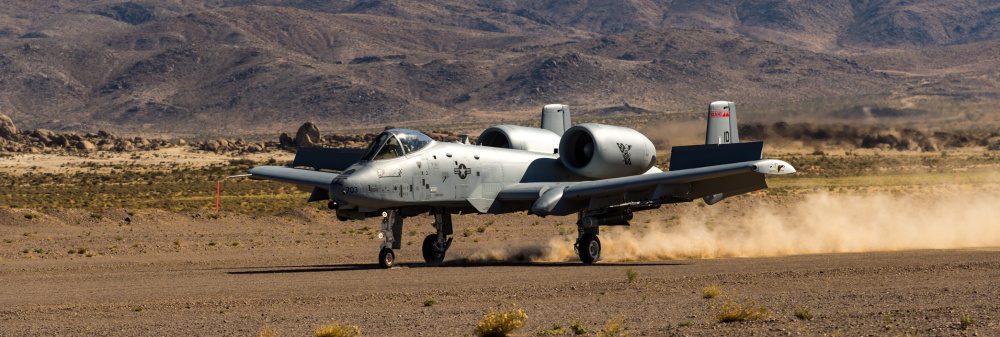
During combat operations, there’s no substitute for the ability to talk face-to-face with a supporting unit. For pilots from the 124th Fighter Wing’s 190th Fighter Squadron, this means landing their A-10 Thunderbolt IIs in a dry lake bed to discuss current operations with the 116th Cavalry Brigade Combat Team’s air liaison officer while supporting the brigade’s National Training Center rotation at Fort Irwin, California, June 4 – 9.
“We can talk about the latest conditions on the battlefield,” said 124th Air Support Operations Squadron Maj. Johnny Reyes, the brigade’s air liaison officer. “They can get the latest update on the commander’s intent for use of close air support.”
The Idaho Air National Guard’s 190th Fighter Squadron is supporting the 116th CBCT’s month-long NTC rotation through its participation in Green Flag-West 19-8, a realistic air-land integration combat training exercise. Pilots launch out of Nellis Air Force Base in Las Vegas to provide close air support to the 116th CBCT in the brigade’s fight against opposing forces provided by the U.S. Army’s 11th Armored Cavalry Regiment.
Pilots spent the week completing qualification landings on the NTC’s Freedom Landing Strip to be prepared to land in austere environments in a combat environment.
“The training gives us confidence we can do it in a combat situation if required,” said Lt. Col. “Champ” Clark, 190th Fighter Squadron commander.
Landing in austere conditions is a task the A-10 Thunderbolt II is well designed for, Clark said. The aircraft’s twin engines are placed high on the aircraft, minimizing the risk the engines could be damaged during landing. Its tires are wide and rugged. Its high ground clearance assists with landing on less-then-ideal surfaces.
“It’s the same as landing on a paved runway, but different,” Clark said. “You have to ensure you land soft and you can’t really break as much as you’d like to. The runway is a little rougher. It’s a little more challenging, so you have to be more careful.”
Once pilots land, they have the ability to communicate directly with Soldiers and Airmen on the ground, including the unit’s air liaison officer, the ground force commanders and their staffs.
Reyes, and the 190th ASOS, is aligned with the 116th CBCT. Because the 124th Fighter Wing’s and the 116th CBCT’s headquarters are located less than a mile apart on Gowen Field in Boise, Reyes is able to fully integrate into the brigade’s staff. Reyes and the unit’s joint terminal attack controllers deploy anywhere the 116th CBCT does to coordinate the use of close air support to support the brigade’s deep fight. The 190th Fighter Squadron’s participation in Green Flag-West happened to coincide with the brigade’s NTC rotation.
“It’s really cool to work with Idaho Army National Guard Soldiers,” Clark said. “Those relationships we build at home, we continue out here and take back with us.”
Rayes said it would tie up brigade communication channels for a significant period of time to communicate all of the latest updates to pilots in the sky. In addition, pilots are able to offer updates to the unit’s maps based off what they saw on their way to the brigade’s tactical operations center, which helps improves the brigade’s common operating picture.
“Pilots serve as an extension of the tactical air control party and get a lot of work done in the deep fight,” Reyes said.
The 116th CBCT’s tactical air control party consists of Reyes, more than a dozen 190th ASOS JTACs, two Marine JTACs and five members of the Brazilian Special Operations Command.
The 116th CBCT, is comprised of 3,000 Soldiers, including 1,800 from 137 Idaho communities and 1,200 Soldiers from the Montana, Nevada and Oregon Army National Guards. The unit is completing a month-long rotation at the National Training Center to build combat readiness and improve Soldier proficiency in their wartime missions. More than an additional 1,000 Soldiers from units in nine Army National Guard states are supporting the 116th CBCT’s rotation. The 116th CBCT is one of five National Guard armored brigade combat teams.
Intel Center of Excellence deputy general visits National Training Center
FORT IRWIN, CA, UNITED STATES
06.05.2019
Story by Capt. Robert Taylor
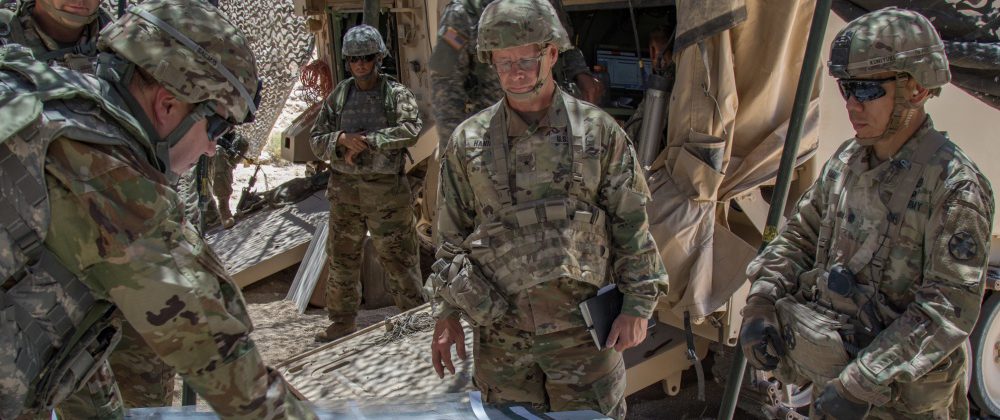
Brig. Gen. Michael K. Hanifan, deputy commanding general, United States Army Intelligence Center of Excellence, visited with 116th Cavalry Brigade Combat Team’s intelligence officers and sections June 3-4, 2019, at the National Training Center in Fort Irwin, California, to see firsthand how the Army’s school for professional training of military intelligence prepares Soldiers to operate in a combat training center environment.
“I saw some sharp leader who knew what they were doing,” he said. “We need to equip them with the correct equipment and training.”
Hanifan said the school, located at Fort Huachuca, Arizona, has recently made three chances to its training requirements to provide Soldiers with effective and relevant training to be successful in their units. Those changes include placing an emphasis on getting away from creating only digital products and enhancing analog skills; shifting away from training on counterinsurgency in favor of decisive-engagement operations; and offering more training in a field environment outside of a classroom
“The changes in our focus has been very affective,” Hanifan said. “We’re headed in the right direction.”
Hanifan saw the effect of those changes on full display as the 116th CBCT’s intel sections worked to track the enemy on the battlefield using a combination of digital systems and analog products in the most realistic decisive-engagement field training environment the Army provides.
Throughout the simulated battle against opposing forces provided by the U.S. Army’s 11th Armored Cavalry Regiment, brigade and battalion intelligence personnel work together to provide commanders at all levels with a common operating picture of friendly and enemy forces’ locations and dispositions.
Information flows up and down echelons across the battlefield to answer commanders’ priority intelligence requirements and to detect, find and destroy enemy assets using available assets, including non-lethal targeting options.
Information collected is analyzed and fed through the brigade’s planning process and current operation cell. Information collected on the battlefield is imperative for commanders and their staffs.
“As elements move forward, we provide the commander with the best enemy picture possible so he can leverage the combat power he has available to make the best decisions possible,” said Capt. William Miller, 2nd Battalion, 116th Cavalry Regiment intelligence officer.
Hanifan, who also serves as the assistant adjutant general, Nevada Army National Guard, believes the National Training Center is the hardest intelligence battle Soldiers will fight, specifically designed to prepare Soldiers for operations in a combat zone. The training provides intel analyst the chance to test their skills against an actual force.
“It’s very realistic,” Spc. Anna Tinseth said. “It’s not notional. What you see on the map is what you’re going to see on the battlefield.”
Tinseth, a 35F intelligence analyst assigned to the Oregon Army National Guard’s 3-116th Cavalry Regiment, said the hands-on experience she is receiving during the 15-day field training exercise is increasing her understanding of her role in a battalion headquarters.
“I’m starting to understand how effective intelligence can be,” she said. “We can better prepare our line units to know what they are going to face on the battlefield.”
The 116th CBCT, one of the National Guard’s five armored brigade combat teams, is completing a National Training Center rotation at Fort Irwin, May 24 – June 20. NTC provides the brigade with the opportunity to train against a near-peer opposing force, challenging Soldiers’ tactical proficiencies and their technical expertise. More than 4,000 Soldiers, including Soldiers from Army National Guard units in 13 states, are participating in the exercise.
Kansas Army National Guard engineers support 116th CBCT
FORT IRWIN, CA, UNITED STATES
06.01.2019
Story by Capt. Robert Taylor
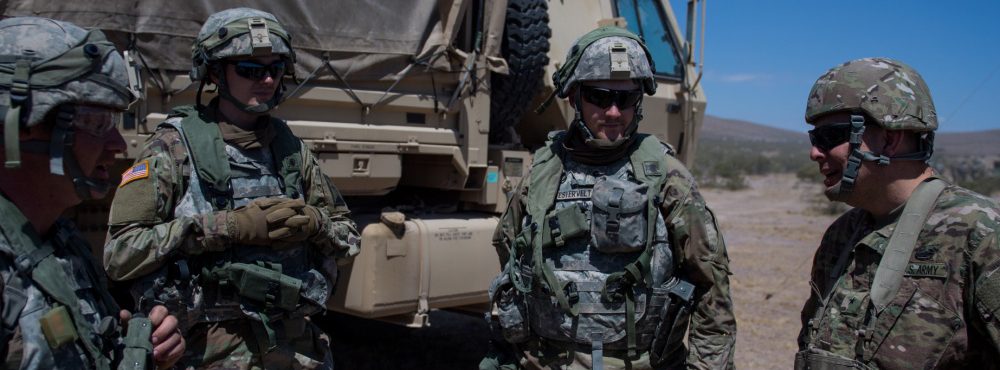
Two companies from the Kansas Army National Guard’s 891st Engineer Battalion are currently completing a rotation at the National Training Center in Fort Irwin, California, to prepare to conduct future real-world missions during unit deployments.
The 242nd Engineer Company, based in Coffeyville, and the 772nd Engineer Mobility Augmentation Company, based in Pittsburgh, are providing engineer support to the Army National Guard’s 116th Cavalry Brigade Combat Team May 24 – June 20.
“Supporting another National Guard unit is what the Guard is all about,” said Brig. Gen. Anthony V. Mohatt, commander, Kansas Army National Guard. “Being able to support another Guard unit is something we’re proud to do as the Kansas Army National Guard and I’m glad we had the opportunity to do so this year.”
The 116th CBCT is one of the National Guard’s five armored brigade combat teams and is comprised of more than 3,000 Soldiers, including roughly 1,800 Idaho Army National Guard Soldiers and 1,200 Soldiers serving in battalions from the Montana, Nevada and Oregon Army National Guard. During the rotation, the brigade is supplemented by units from nine additional Army National Guard states and three U.S. Army Reserve units for a total force of more than 4,000 Soldiers.
The 772nd MAC enhances the brigade’s 116th Brigade Engineer Battalion’s mobility assets with its assault, breaching and counter-mobility equipment, including Assault Breacher Vehicles, the Volcano Mine System and M58 Mine Clearing Line Charges. Combat engineers also provide increased obstacle placement capabilities.
The 242nd Engineer Company provides the brigade with heavy construction equipment to dig anti-vehicle ditches, vehicle fighting positions and other survivability positions. Two of the company’s platoons are currently attached to the 116th BEB’s organic engineer companies.
The rotation provides both companies with the opportunity to execute its wartime missions in a tactical environment in the most realistic training environment the Army can provide.
“The training improves our lethality,” said Capt. Kevin Hubbard, 242nd Engineer Company commander. “We’re ready to deploy anywhere in the world.”
Throughout the rotation the 116th CBCT, headquartered in Boise, Idaho, will engage the U.S. Army’s 11th Armored Cavalry Regiment in force-on-force simulated combat operations against a near-pear adversary.
“Coming to a NTC rotation allows for individual Soldier development, leader development and increased unit readiness to be ready for our federal mission when called upon.”
For Spc. Frankie Moore, a 772nd MAC 12B combat engineer, NTC also offers him the chance to spend additional time with his battle buddies.
“I love hanging out with the guys,” Moore said. “The comradery, trust and friendship I have with Soldiers is something I don’t have in the civilian world. I miss it from deployments.”
Idaho National Guard marksmanship team trains with local Treasure Valley sniper police
MELBA, ID, UNITED STATES
06.09.2019
Story by Master Sgt. Becky Vanshur
MELBA, Idaho – “Everybody wants to be a sniper, until it’s time to do the sniper stuff,” said Cpl. Brian Lueddeke, a sniper instructor from the Meridian Police Department. “It’s just what it is, right, the hard truth. We are called lizards because we are out there lying on the hot rocks baking ourselves, or we are up on a rooftop blanketed by snow in a blizzard.”
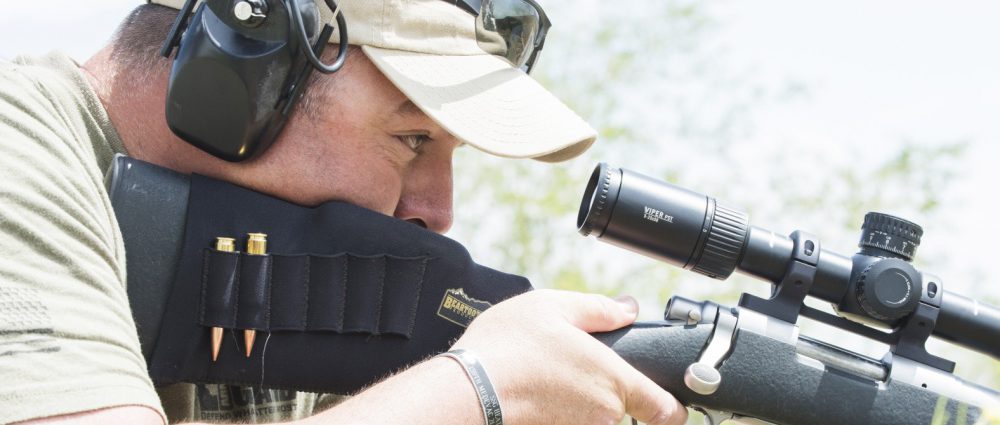
The Idaho National Guard marksmanship team participated for the first time in the urban and rural sniper training held in Melba by the Treasure Valley’s SWAT sniper element. The Meridian Police Department sponsored the course and the SWAT team instructors volunteered their time to produce the intense 50-hour, five-day course, held from June 3 through June 7.
Police officers from the Ada County sheriff’s office, Gem County sheriff’s office and Soldiers from Idaho National Guard completed their week of training with a certified qualification exam. These are essential skills necessary to operate effectively as a designated precision marksman, commonly referred to as DPM, or sniper.
The two most essential skills learned were marksmanship and field craft. Marksmanship is engaging select targets with consistent precision fire and the use of a bolt-action scope riffle. Field craft is the ability to effectively detect, observe and report critical information to their operational command while remaining in a concealed position.
“What are some things in the urban environment that can cause us problems when we are out on a mission? Sound. Yes, but that can also be a cover,” said Lueddeke. “People. Yes, the lookie-loos. Everybody flocks to where the police are and now you have all sorts of issues in the event that you run into an immediate threat situation and need to take a shot. Vision obstruction from buildings and wind compression problems can occur more frequently in the urban environment than in a rural environment.”
As the course concluded, a sniper now has the training and discipline to research an objective and pre-select locations where they can move into undetected to observe their objective.
“Everyone sees us as just shooters but that’s not really what it is,” said Patrol Officer Travis Woodbury, from the Nampa Police Department and a volunteer sniper instructor for the course. “It is a constant surveillance roll. We are information gathers before we are anything else. For example, if we gather enough information from a reconnaissance surveillance, and report it back, it might just be enough information to issue a search warrant from command.”
The city of Melba and Melba High School graciously volunteered classroom space, building rooftops and shooting ranges in support of the joint training.
The military and the police departments across the Treasure Valley have continued to work together throughout the years in real-world missions as well as in a training scenario like this one.
“The joint relationship between the Idaho National Guard and the Police Department is great. We love them, they love us,” said Patrol Sgt. Chris Bones, an Ada County SWAT member, who is also training to be on the sniper team. “I think what bolsters that relationship is a lot of deputies are either current military or former military, and that naturally forms a common bond, especially when we get into a training environment together.”
It may be the first sniper training for the Idaho National Guard marksmanship team Soldiers, but they foresee a future of continuous joint training.
The Idaho National Guard’s 2nd of the 116th Calvary Brigade Combat Team started their sniper program just over a year ago and formed their small sniper scout platoon.
“The marksmanship team is coming out here so that we can start building the foundation for future training within our own sniper program,” said Sgt. 1st Class Jared Frogley, the IDNG state marksmanship NCO in charge. “We are heavily involved with our sniper team and I believe we are going see this type of joint training continue.”
A successful first year for the Idaho National Guard STARBASE program
BOISE AIR TERMINAL AIR GUARD STATION, ID, UNITED STATES
06.07.2019
Story by Master Sgt. Becky Vanshur
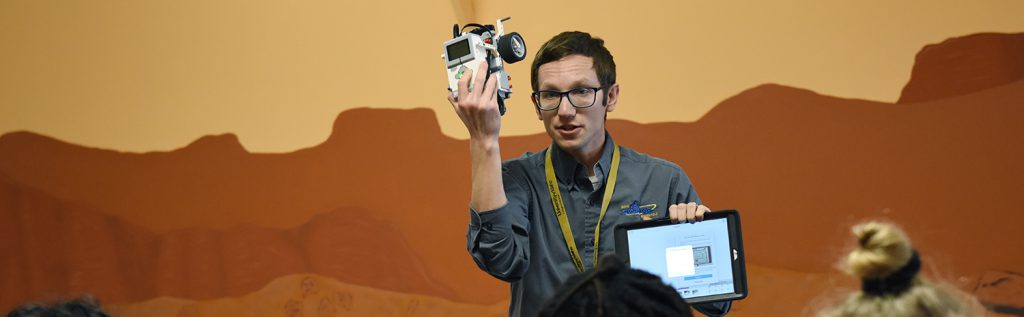
GOWEN FIELD, Idaho – As summer approaches, the Idaho National Guard’s STARBASE Idaho program completed its first school year with a successful outcome of more than 1,700 fifth grade students who participated throughout the year in the well-known science, technology, engineering and mathematics curriculum, also referred to as STEM.
The five-week STARBASE Idaho program is funded by the Department of Defense and brings a nontraditional way of teaching students from around the Treasure Valley.
“This program is definitely designed differently than a traditional classroom setting, in that students are more actively engaged in the experiments through a more hands-on approach,” said Amy Cook, a current instructional aide at the STARBASE Idaho program.
Not all schools have the funding available to accommodate the growing and ever-changing technological side of the curriculum. This year, 23 Title I schools that were lacking sufficient STEM resources were able to participate in this program. Title I schools are government funded public schools that receive supplemental funds to assist with meeting students’ educational goals.
“As a teacher, I am finding success in students that maybe weren’t as successful in a traditional classroom because they can be more physically engaged here,” said Courtney Taylor, a current teacher at the STARBASE Idaho program. “It is reinforcing to know this program does work because not all students learn the same way. Not all students have access to the programs that explore this type of knowledge and provide these types of hands-on lessons.”
The past 12 months’ curriculum taught valuable skills and lessons to several elementary schools from six different school districts. The school districts of Boise, Caldwell, Kuna, Middleton, Nampa and West Ada bussed students onto Gowen Field to participate in the program, with the addition of several homeschooled students.
Students learned by being physically involved in the engineering and design process of 3D printing on computers. They wrote coding programs for robotics that incorporated the ability to overcome failure if their coding didn’t program the robot to follow the correct path. They mixed chemicals to cause reactions, learned about physical and chemical properties, states of matter, elements and atoms, nanotechnology, laws of motion, units of measurements, fractions, decimals, percentages, and much more.
“My favorite part of the program is that the students get the chance to learn through failure,” said Kimberly Avella, a current teacher at the STARBASE Idaho program. “If you don’t get it right the first time, you get the valuable lesson of trial and error through the failure process of these experiments.”
Additionally, the STARBASE Idaho program allowed for guided tours of Gowen Field and an opportunity to meet with Airman and Soldier STEM role models from aircraft maintainers, civil engineers, firefighters, armor instructors, army aviators and emergency and environmental managers.
Currently, 35 other states have STARBASE programs, which are federally funded and typically located on military instillations.
“We are also a nonprofit organization,” said Jim Heuring, director of STARBASE Idaho. “We can receive private donations and we do. We use some of that money we are receiving from private donors to pay for bussing for the schools that cannot afford to provide transportation. We also use the money for the extra supplies we may need.”
Congress votes on the Department of Defense bill for the program annually. Once the bill is approved, a cooperative agreement within each state pays for the facilities, equipment and supplies, as well as the staff and the teachers who are all State of Idaho Military Division employees.
“It is humbling to be a part of something that sparks their interests, to be able to see the students realize that there are so many different options available to them,” said Taylor. “From the beginning to the end, they seemed more and more eager to learn each day as the five weeks continued on. In such a short amount of time, it was just remarkable to watch them grow and to leave the program believing in themselves.”
Command Sgt. Maj. Randolph takes cares care of Soldiers
FORT IRWIN, CA, UNITED STATES
06.02.2019
Story by Capt. Robert Taylor
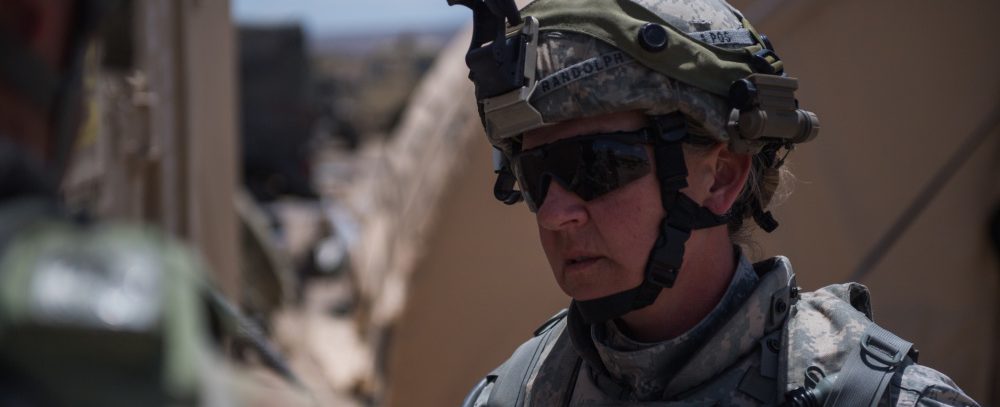
Command Sgt. Maj. Alice Randolph knows she’s the 116th Cavalry Brigade Combat Team’s senior female noncommissioned officer, but it’s not something she spends a lot of time thinking about.
“I identify as a command sergeant major,” Randolph said.
As the 145th Brigade Support Battalion’s command sergeant major, Randolph’s primary mission is the taking care of the battalion’s 300 enlisted Soldiers.
“Taking care of Soldiers means teaching them, training them and mentoring them,” she said. “The best part of the job is watching Soldiers grow throughout their careers.”
Randolph enlisted into an U.S. Army Reserve unit when she was 17 and four years later transferred into Idaho Army National Guard.
“It was the best decision of my life,” she said. “The Army has been really good to me.”
Randolph has served as a 68W combat medic throughout her career. She’s spent the majority of her career in the 145th BSB, including time as a platoon sergeant and company commander before she was appointed to the battalion’s top enlisted spot in May 2017.
“I love 145th BSB Soldiers,” she said. “They really are the best group of Soldiers I’ve worked with. With most of the unit located in Northern Idaho, we have to be close knit.”
The 145th BSB provides logistic support to the 116th Cavalry Brigade Combat Team. Its distribution company, A Company, and maintenance company, B Company, are both located in Post Falls. The unit’s brigade support medical company is located in Boise. The battalion’s headquarters is located in Lewiston, along with detachments from B and C companies. Forward support companies are attached to each of the brigade’s seven battalions to provide direct support.
As the battalion’s senior enlisted member, she serves as a member of the commander’s personal staff and provides him technical and tactical advice on the planning, training, preparation and execution of all unit missions. As the only female sergeant major in the battalion, she said it’s not uncommon for her to be the only female in senior brigade leader meetings.
“I’ve gotten used to being include in ‘gentlemen,’” she said, while adding she’s never felt she’s been treated differently throughout her career because she is a female Soldier.
The battalion is currently supporting the 116th Cavalry Brigade Combat Team’s National Training Center rotation at Fort Irwin, California, which offers the unit the opportunity to sustain one of the National Guard’s five armored brigade combat teams across an astute environment roughly the size of Rhode Island. The U.S. Army’s 11th Armored Calvary Regiment provides the brigade with a near-peer opposing force, challenging Soldiers in the unit’s tactical proficiencies as well as its technical expertise.
“No matter how hard things get, the Soldiers make it fun and get the job done,” she said.
Like father like sons, Bundy brothers serve together
FORT IRWIN, CA, UNITED STATES
06.01.2019
Story by Capt. Robert Taylor
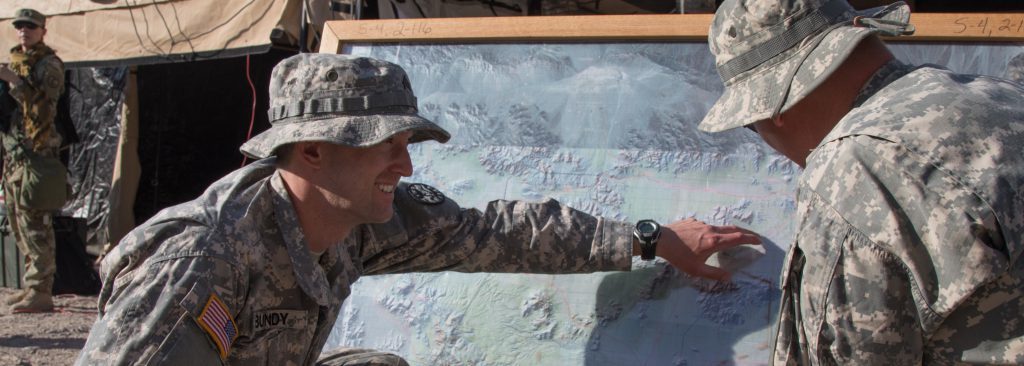
Idaho Army National Guard Soldiers 2nd Lt. Zane Bundy and his big brother Sgt. Nathan Bundy take after their father, Mountain Home city councilman Matt Bundy, in a number of ways.
All three work for the Mountain Home School District. Matt and Nathan both teach at Mountain Home High School and Zane is a substitute teacher who hopes to have his own classroom someday. In addition, all three either have, or are currently serving in the military.
Matt retired from the United States Air Force. Nathan and Zane both serve in the 116th Cavalry Brigade Combat Team’s 2nd Battalion, 116th Cavalry Regiment, headquarted in Caldwell. For the next couple weeks, both are participating in the brigade’s National Training Center at Fort Irwin, California.
“I was raised on the idea of serving my country,” said Nathan, who enlisted into the Idaho Army National Guard in 2012 as a 35F intelligence analyst.
Nathan is the intelligence section’s senior noncommissioned officer. His team’s job is to help analyze intel Soldiers in the combined arms battalion collect to help his battalion commander make good decisions on the battlefield.
It’s a position that’s vastly different than Zane’s job, who leads a platoon in Idaho’s only infantry company from his Bradley Fighting Vehicle.
“Serving together gives us a new dynamic in our relationship,” Nate said. “It’s a new common ground and a shared experience, but we’re also on different sides of the Army as an enlisted intel Soldier and an infantry officer.”
Zane joined the Idaho Army National Guard in January 2017 and later earned his commission in November 2017.
“I saw how great of an opportunity Nate had to be in the Guard so I thought I would follow,” Zane said.
At his commissioning ceremony, Nathan was the first to salute his younger brother of four years.
“I was really proud of him when he commissioned,” Nathan said.
Zane said he doesn’t get to see much of his brother during unit operations but that it’s always good to see him when the two cross paths. Both agreed that serving in the National Guard provides them with experiences they don’t get to have in the classroom as teachers.
“I enjoy both jobs,” Nate said. “Being able to serve part-time is a great experience.”
The 116th Cavalry Brigade Combat Team is completing a month-long rotation at the National Training Center to build unit readiness and increase Solider proficiency in their wartime missions. The unit will train against a near-peer opposing force provided by the Army’s 11th Armored Cavalry Regiment. More than 4,000 Soldiers, from more than 30 Army National Guard states, are participating in the exercise.
Viva Las Vegas – The 124th Fighter Wing Arrives at Green Flag-West
LAS VEGAS, NV, UNITED STATES
06.02.2019
Story by Master Sgt. Joshua Allmaras
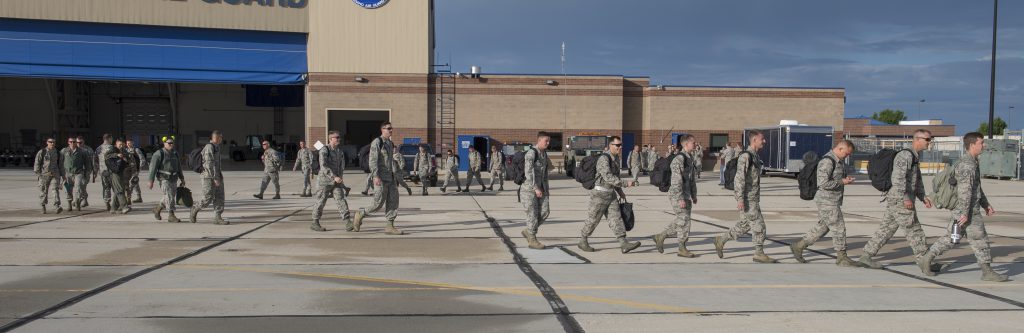
More than 190 Airmen from the 124th Fighter Wing, Boise, Idaho and 12 A-10 Thunderbolt II aircraft from the 190th Fighter Squadron arrived at Nellis Air Force Base, Nevada, May 30, 2019.
The aircraft and Airmen are participating in Green Flag-West 19-8, a realistic air-land integration combat training exercise. This exercise will heavily support the Idaho Army National Guard’s 116th Cavalry Brigade Combat Team, who are training at the Fort Irwin National Training Center in California in preparation for an overseas deployment.
“This training is invaluable to our pilots, maintenance and support Airmen,” said Col. Shannon Smith, the 124th Fighter Wing commander. “It allows us the opportunity to hone our close air support skills, validate joint interoperability and achieve combat readiness.”
Not only is this training valuable to the wing, but it directly supports our fellow guardsmen.
“We not only will be enhancing our combat lethality, but we will directly be supporting our fellow guardsmen in the Idaho Army National Guard during our Green Flag rotation,” said Smith. “Nothing hits home more than knowing you are directly supporting your fellow brothers and sisters from the Idaho National Guard.”
Out of the 3,000 soldiers that comprise the 116th CBCT, more than 1,800 are from 137 Idaho communities. The training is key to the success of the soldiers.
“The national training center provides some of the most realistic training the Army has to offer,” said Col. Scott Sheridian, the 116th CBCT commander. “This gives us the opportunity to exercise our warfighting functions in a way we can’t anywhere else.”
This Army deployment is the largest in the 116th CBCTs history, but that’s not the only first.
“From what I understand, this is the first time that both an air and land component from the same state have supported each other in both the Green Flag and NTC training environment,” said Smith. “This is one of those unique opportunities to directly and positively impact the overall combat readiness of the entire Idaho National Guard.”
116th CBCT arrives at the National Training Center
FORT IRWIN, CA, UNITED STATES
05.28.2019
Story by Capt. Robert Taylor
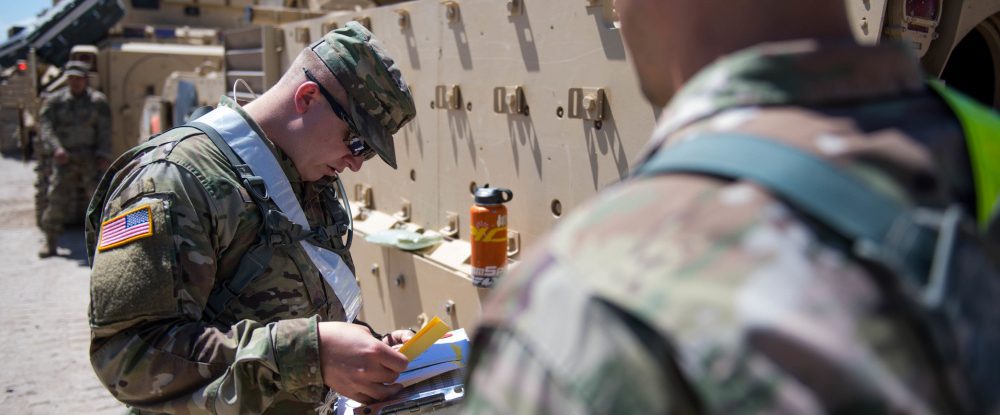
Soldiers from the Idaho Army National Guard’s 116th Cavalry Brigade Combat Team have mobilized to the National Training Center at Fort Irwin, California, to participate in a large-scale exercise. This deployment is the state’s largest since 2015.
“The National Training Center provides some of the most realistic training the Army has to offer,” said 116th CBCT commander Col. Scott Sheridan. “This gives us the opportunity to exercise our warfighting functions in a way we can’t anywhere else. 116th CBCT Soldiers have trained extensively over the past four years and are ready to demonstrate their tactical and technical proficiencies in an austere environment.”
The 116th CBCT is comprised of more than 3,000 Soldiers, with roughly 1,800 Soldiers from 137 Idaho communities and 1,200 Soldiers serving in battalions from the Montana, Nevada and Oregon Army National Guards.
Through force-on-force simulated combat operations, Soldiers will have the rare opportunity to train against a near-peer force, provided by the U.S. Army’s 11th Armored Cavalry Regiment. Soldiers will also live-fire major weapon platforms, to include the M1A1/A2 Abrams Main Battle Tank, the M2A3/M3 Bradley Fighting Vehicle, the M109A6 Paladin and the M58 Mine Clearing Line Charge.
The NTC is one of the Army’s largest combat training centers and is roughly the size of Rhode Island. Its desolate climate and varied terrain will test the brigade’s ability to sustain itself in a large and austere environment.
More than 1,000 Soldiers in Army National Guard units from eight additional states and Puerto Rico, along with three U.S. Army Reserve units, will join forces with the 116th during the rotation to complete the brigade’s combat power. In addition, the Idaho Air National Guard’s 124th Fighter Wing will provide close air support using A-10 Thunderbolt II aircraft during the 116th CBCT’s simulated combat operations.
“Everybody in this task force is a member of the 116th CBCT regardless of the patch on your shoulder,” Sheridan told senior battalion leaders Sunday during a unit movement rehearsal.
The task force comprises an additional 56 National Guard companies, platoons or sections, to include the Arizona Army National Guard’s 158th Combat Sustainment Support Battalion and the California Army National Guard’s 1st Assault Helicopter Battalion of the 140th Aviation Regiment.
The 116th CBCT last attended the NTC in 2015. The training rotation is the brigade’s capstone training event in its four-year training cycle before the unit is available to complete a real-world mission in 2020.
IDAHO ARMY NATIONAL GUARD UNIT WELCOMED HOME FROM AFGHANISTAN DEPLOYMENT

SUN VALLEY, ID, UNITED STATES
05.18.2019
Story by Capt. Robert Taylor
Soldiers from the Idaho Army National Guard’s Detachment 2, C Company, 1-168th General Support Aviation Battalion were welcomed home from the unit’s deployment to Afghanistan by Gov. Brad Little and senior Idaho National Guard leaders in a Yellow Ribbon Ceremony in Sun Valley Saturday.
More than 30 Soldiers from the unit deployed to Fort Hood in April 2018 for training and then to Afghanistan in support of Operation Freedom’s Sentinel. Soldiers began returning individually in February and the ceremony marked the first time the unit reunited since leaving Afghanistan.
“I am extremely proud of the professional service each member of this unit provides to our state and nation and very grateful that they all returned safely home to their loved ones,” said Maj. Gen. Michael Garshak, adjutant general of Idaho and commander, Idaho National Guard. “This service requires many sacrifices, not only from the deploying Guardsmen, but even more so, from their families who carry on while they are gone. We are committed to providing our Guardsmen and families with all the possible care and support as they integrate back into their lifestyles here in Idaho.”
The UH-60 Black Hawk unit provided aeromedical evacuation support for the 101st Combat Aviation Brigade in the Kandahar and Helmand providences. Throughout the deployment, Medevac crews collectively flew approximately 100 missions and more than 1,000 hours.
Soldiers worked 24-hour shifts and had 15 minutes to be in the air to respond to calls from up to 40 miles away.
“It’s an instant adrenaline rush,” said flight paramedic Staff Sgt. David Egersdorf. “There’s nothing I can compare saving someone’s life to, whether it’s an American, an Afghanistani or a foreign service member, it’s fulfilling.”
As an aeromedical evacuation unit, its UH-60L Black Hawk helicopters are equipped with defibrillators, medical fluids, oxygen tanks, medications and other advanced combat life-saving tools in addition to an external hoist system and forward-looking infrared cameras. Flight crews consist of two pilots, a crew chief and flight paramedic.
The detachment stood up in March 2017. Prior to deploying, aviators and crew chiefs had to be trained on hoist operations and other critical medevac procedures. Combat medics from other Idaho Army National Guard units were selected and trained as flight paramedics.
“In less than a year, everyone came together to help stand up the unit, learn the mission and mobilize,” said 1st Lt. Morgan Hill, detachment commander. “Not only did we go over there, do our jobs and have everyone come home in one piece, we saved lives on the battlefield. There are people alive today because of the efforts everyone put in the past two years.”
During the deployment, the unit worked closely with similar units from the Maine and Washington D.C. Army National Guards to provide medical support to coalition forces.
The Department of Defense’s Yellow Ribbon Program provides assistance to National Guard and Reserve members before, during and after deployments by connecting unit members and their families with local resources and information regarding health care, education and financial and legal benefits. Soldiers and their families attended a Yellow Ribbon event prior to the unit’s deployment and family members attended an event during the unit’s deployment.
Unit members and their families are in Sun Valley to attend a two-day reintegration program, which concludes Sunday.
This deployment marks the eighth time in the past decade an Idaho Army National Guard aviation unit deployed.