 Official Government Website
Category: Idaho National Guard
Idaho Army National Guard returns from Guatemala

Courtesy story
Idaho National Guard
Approximately 150 Soldiers from Idaho’s 1st Battalion of the 183rd Assault Helicopter Battalion returned home Saturday after deploying to Huehuetenango, Guatemala, in support of Beyond the Horizon 2019.
During the operation, Idaho Army National Guard aviation Soldiers provided casualty evacuation support and equipment transportation for U.S. military engineers and medics building local schools and medical clinics.
“We had the opportunity to change lives and be part of a mission that brought dramatic change to the economic growth of Huehuetenango,” said Maj. Bryan Reid, the unit’s operations and training officer. “The experience was life changing and I am grateful to have had the opportunity to participate.”
Soldiers from the unit consisting of crew chiefs, mechanics, petroleum specialists, signal specialists and supply personnel rotated through Guatemala in two-week rotations from April 28 to July 27. They completed 50 missions and 210 flight hours, to include transportation of 600 passengers and 9,000 pounds of cargo.
In addition, the Idaho Army National Guard Soldiers conducted joint training with soldiers from the Guatemalan Armed Forces. The training gave participants the opportunity to share skills and practice loading injured individuals into UH-60 Black Hawks.
“The training provided unique opportunities that challenged everyone throughout our missions,” said Chief Warrant Officer 3 K Kirkendall, Idaho’s aviation training officer. “I’ve never experienced flying missions in an environment such as this and it will forever leave a mark on my career as a pilot.”
Beyond the Horizon is a U.S. Southern Command-sponsored, joint foreign military humanitarian civic assistance exercise. Hundreds of Active Duty, National Guard and Reserve members from all services participate annually to help build relations with the host nation.
101st CST trains with Nampa Police Department
Capt. Robert Taylor
Idaho Army National Guard
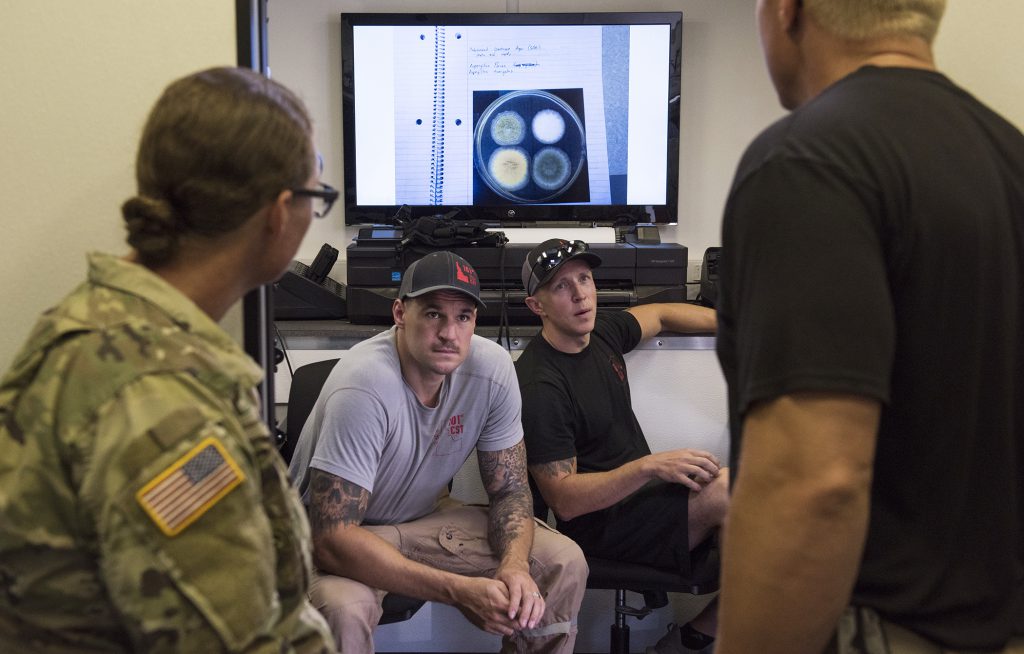
NAMPA, Idaho – Soldiers and Airmen from the Idaho National Guard’s 101st Weapons of Mass Destruction Civil Support Team responded to a training incident in Nampa to support the Nampa Police Department July 24.
The training event, held at the empty building that formally housed the Mercy Medical Center, tested the unit’s ability to deploy without notice to a local incident. The Nampa Police Department requested the 101st CST support to complement its own training at the facility simultaneously.
“It’s good to know what support we have nearby so we’re not having officers putting themselves into dangerous situations when we have other resources available,” said Nampa Police Department Sgt. Jason Cantrell.
The training scenario focused on a chemical lab that was discovered while the Nampa Police Department investigated reports of suspicious behavior. The department requested the 101st assistance because the regional hazmat team was unavailable, a scenario that could happen in the event of a real-world incident.
Cantrell explained it was more practical and safe to request support from the 101st to investigate unknown chemical agents than to send a police officer into the building wearing a gas mask. The 101st was able to report to the scene in less than two hours after notification.
The 101st trains year-round and often with local first responder agencies. The 22-person team is one of 57 CST units in the National Guard across the country. Each team provides unique expertise and capabilities to assist state governors in preparing for and responding to chemical, biological, radiological or nuclear incidents and natural disasters as part of each state’s emergency response structures.
“It’s nice to build relationships with first responders so we can put faces to names if there is a real-world event,” said Sgt. 1st Class Richard Bachmeier, the unit’s communication section chief.
The 101st has worked with the Nampa Police Department on real-world missions in the past. In March, the unit responded to the same parking lot after the Nampa Police Department received a bomb threat involving a nearby apartment complex. Units did not find any suspicious items or substances and police arrested a suspect in connection to the threat.
In February 2018 the 101st and Nampa Police Department worked together with other local agencies in a large-scale training event at the Ford Idaho Center.
“We enjoy our relationship with the 101st,” Cantrell said. “Training together allows us to be able to get a better understanding of their capabilities and operating procedures to facilitate something of this magnitude.”
Brig. Gen. Nolan retires after nearly 35 years of service
By Master Sgt. Becky Vanshur
Idaho Air National Guard
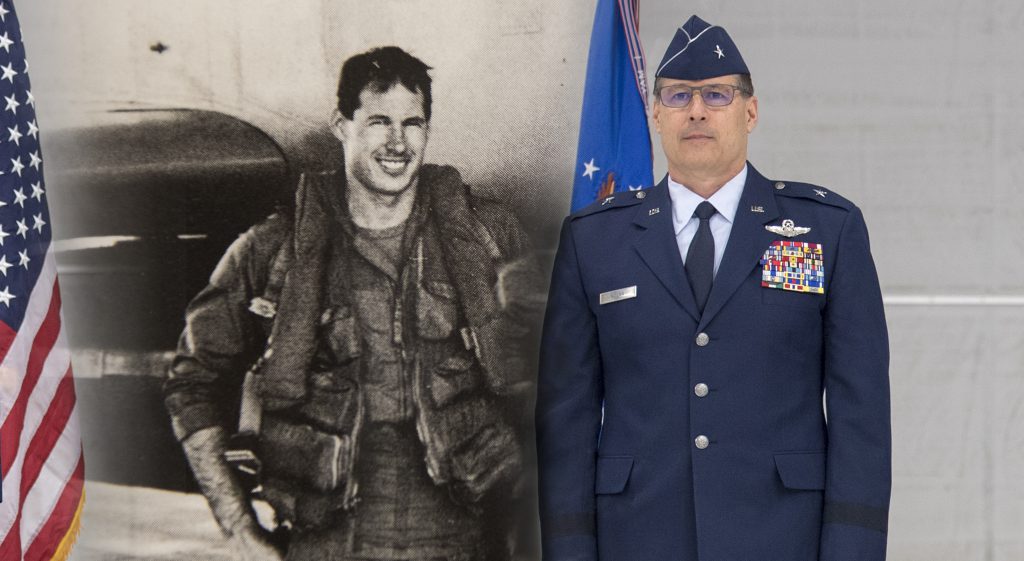
Gowen Field, Idaho – After nearly 35 years of service, Brig. Gen. Michael A. Nolan, former Assistant Adjutant General-Air, Idaho Air National Guard, retired at a ceremony at Gowen Field on July 17. As his career comes to an end, Nolan realizes the bond and experiences he shares with others are what is most important to him.
“It’s the people you work with every day that you have a common experience with,” said Nolan. “This shared experience brings you close to each other as a team. It brings out the best in each of us, we come together, and we share together. As I retire, I will now be on the outside of this, but I will still have that shared common experience with all of these great people.”
Nolan was previously the commander of the 124th Fighter Wing at Gowen Field and was a pilot, flying missions with the F-4E and F-4G Phantom II aircraft and the A-10 Thunderbolt II aircraft.
Before he joined the Idaho Air National Guard, Nolan was an F-4G pilot instructor in California and met several Idaho pilots there. He decided to turn down an active duty Air Force pilot bonus in October 1992 and seven days later he moved to Idaho to fly the F-4G assigned to the 190th Fighter Squadron.
“The best decision I ever made was to move here,” said Nolan. “My experience in the Guard has been remarkable and I felt really fortunate to be welcomed, to be given the opportunities I was given, and to be trusted.”
When Idaho’s mission changed in 1996, Nolan transitioned to an A-10 Thunderbolt II pilot. Although he flew F-4 missions, the A-10 mission was his passion.
“The Warthog is a phenomenal machine,” said Nolan. “The A-10 mission had much more of an impact on me than my other flying experiences.”
Five years ago, Nolan flew his last A-10 flight as the 124th Fighter Wing commander and was promoted to command the Idaho Air Guard.
Nolan said that one of his greatest leadership moments as the Assistant Adjutant General was being involved in ending the concept of moving the Idaho Air National Guard to Mountain Home Air Force Base and transitioning to the F-15E mission.
“The Strike Eagle at Mountain Home is an awesome mission; it just wasn’t for us as a local, community-based Guard unit,” said Nolan. “Parallel to keeping us in Boise, was the fight to keep and modernize our A-10s.”
To Nolan, his military career was about more than just flying the F-4 and A-10 missions.
“People join the military for various reasons, for me it was that I wanted to fly jets, but then once you’re in the military you realize that you are part of something that is much bigger than yourself,” said Nolan.
Two Idaho Guardsmen earn air assault badges
Capt. Robert Taylor
Idaho Army National Guard
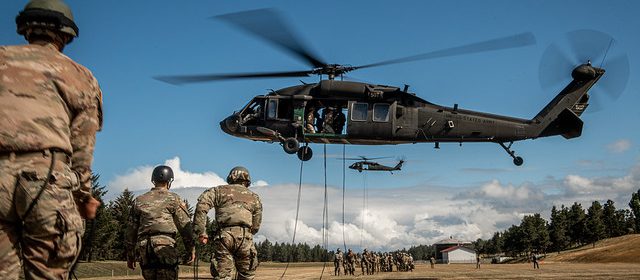
Two Idaho National Guardsmen graduated from the U.S. Army’s Air Assault School June 28 at Camp Rilea, Oregon. Idaho Army National Guard Soldier Cadet Porter Haux and Idaho Air National Guard Airman Senior Airman Matthew McKee completed the 10-day course to earn their air assault badges.
In addition to completing air assault school, McKee also graduated from the Army’s Rappel Master Course July 3.
“They were both good courses,” McKee said. “It was a good experience.”
McKee, a tactical air control party specialist with the 124th Fighter Wing’s 124th Air Support Operations Squadron, spent eight years in the Army Reserve before joining the Idaho Air National Guard in January 2018.
He becomes the unit’s third rappel master, which gives the squadron the required number of qualified airmen to conduct its own rappel training. The unit plans to train with the Idaho Army National Guard’s 1-183rd Assault Helicopter Battalion, which flies UH-60 Black Hawks.
The battalion’s Black Hawks supported the training courses, which included the Army’s Pathfinder Course.
Haux, a junior in Boise State University’s ROTC program, said he attended the course to become a better Soldier.
“I figured air assault course was something that I could do to better myself and further my career while doing something few people learn how to do,” he said. “I got paid to learn how to rappel from a helicopter, which is something people probably would pay a lot of money to learn how to do.”
Haux has served in the Idaho Army National Guard since November 2017. His father, Maj. Kelly Haux, is an active duty officer.
“It’s been my dream to be a Solider since I was capable of dreaming,” Haux said. “I always wanted to be a Soldier like my dad.”
The air assault course featured 10 days of instruction in three phases; combat assault operations, sling load operations and rappelling.
In phase one Soldiers and Airmen received training on combat assault, aircraft orientation, aircraft safety, aeromedical evacuation, pathfinder operations and hand and arm signals. In phase two they learned to prepare, rig and inspect various military sling-loads for equipment and vehicles such as the M998 HMMWV and M1102 Cargo Trailer. In the final phase Soldiers received instruction on tying a rappel seat, hook-up techniques, lock-in procedures, belay procedures and rappelling.
Throughout training students received several written and performance-oriented tests, conducted multiple runs and foot marches and rappelled from multiple towers and rotary wing aircraft.
Towards the end of the course, Soldiers demonstrated what they learned while repelling from a Black Hawk 90 feet above the ground.
Back to Newsroom
Join the Idaho Air National Guard
Idaho National Guard marksmanship team trains with local Treasure Valley sniper police
MELBA, ID, UNITED STATES
06.09.2019
Story by Master Sgt. Becky Vanshur
MELBA, Idaho – “Everybody wants to be a sniper, until it’s time to do the sniper stuff,” said Cpl. Brian Lueddeke, a sniper instructor from the Meridian Police Department. “It’s just what it is, right, the hard truth. We are called lizards because we are out there lying on the hot rocks baking ourselves, or we are up on a rooftop blanketed by snow in a blizzard.”
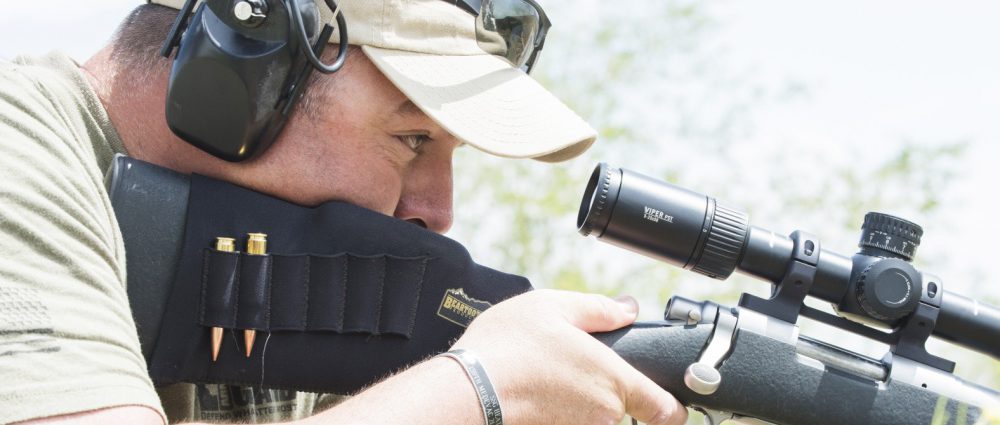
The Idaho National Guard marksmanship team participated for the first time in the urban and rural sniper training held in Melba by the Treasure Valley’s SWAT sniper element. The Meridian Police Department sponsored the course and the SWAT team instructors volunteered their time to produce the intense 50-hour, five-day course, held from June 3 through June 7.
Police officers from the Ada County sheriff’s office, Gem County sheriff’s office and Soldiers from Idaho National Guard completed their week of training with a certified qualification exam. These are essential skills necessary to operate effectively as a designated precision marksman, commonly referred to as DPM, or sniper.
The two most essential skills learned were marksmanship and field craft. Marksmanship is engaging select targets with consistent precision fire and the use of a bolt-action scope riffle. Field craft is the ability to effectively detect, observe and report critical information to their operational command while remaining in a concealed position.
“What are some things in the urban environment that can cause us problems when we are out on a mission? Sound. Yes, but that can also be a cover,” said Lueddeke. “People. Yes, the lookie-loos. Everybody flocks to where the police are and now you have all sorts of issues in the event that you run into an immediate threat situation and need to take a shot. Vision obstruction from buildings and wind compression problems can occur more frequently in the urban environment than in a rural environment.”
As the course concluded, a sniper now has the training and discipline to research an objective and pre-select locations where they can move into undetected to observe their objective.
“Everyone sees us as just shooters but that’s not really what it is,” said Patrol Officer Travis Woodbury, from the Nampa Police Department and a volunteer sniper instructor for the course. “It is a constant surveillance roll. We are information gathers before we are anything else. For example, if we gather enough information from a reconnaissance surveillance, and report it back, it might just be enough information to issue a search warrant from command.”
The city of Melba and Melba High School graciously volunteered classroom space, building rooftops and shooting ranges in support of the joint training.
The military and the police departments across the Treasure Valley have continued to work together throughout the years in real-world missions as well as in a training scenario like this one.
“The joint relationship between the Idaho National Guard and the Police Department is great. We love them, they love us,” said Patrol Sgt. Chris Bones, an Ada County SWAT member, who is also training to be on the sniper team. “I think what bolsters that relationship is a lot of deputies are either current military or former military, and that naturally forms a common bond, especially when we get into a training environment together.”
It may be the first sniper training for the Idaho National Guard marksmanship team Soldiers, but they foresee a future of continuous joint training.
The Idaho National Guard’s 2nd of the 116th Calvary Brigade Combat Team started their sniper program just over a year ago and formed their small sniper scout platoon.
“The marksmanship team is coming out here so that we can start building the foundation for future training within our own sniper program,” said Sgt. 1st Class Jared Frogley, the IDNG state marksmanship NCO in charge. “We are heavily involved with our sniper team and I believe we are going see this type of joint training continue.”
A successful first year for the Idaho National Guard STARBASE program
BOISE AIR TERMINAL AIR GUARD STATION, ID, UNITED STATES
06.07.2019
Story by Master Sgt. Becky Vanshur
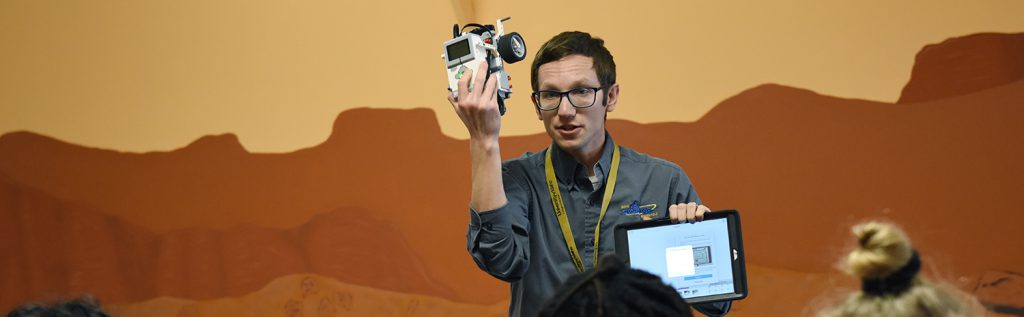
GOWEN FIELD, Idaho – As summer approaches, the Idaho National Guard’s STARBASE Idaho program completed its first school year with a successful outcome of more than 1,700 fifth grade students who participated throughout the year in the well-known science, technology, engineering and mathematics curriculum, also referred to as STEM.
The five-week STARBASE Idaho program is funded by the Department of Defense and brings a nontraditional way of teaching students from around the Treasure Valley.
“This program is definitely designed differently than a traditional classroom setting, in that students are more actively engaged in the experiments through a more hands-on approach,” said Amy Cook, a current instructional aide at the STARBASE Idaho program.
Not all schools have the funding available to accommodate the growing and ever-changing technological side of the curriculum. This year, 23 Title I schools that were lacking sufficient STEM resources were able to participate in this program. Title I schools are government funded public schools that receive supplemental funds to assist with meeting students’ educational goals.
“As a teacher, I am finding success in students that maybe weren’t as successful in a traditional classroom because they can be more physically engaged here,” said Courtney Taylor, a current teacher at the STARBASE Idaho program. “It is reinforcing to know this program does work because not all students learn the same way. Not all students have access to the programs that explore this type of knowledge and provide these types of hands-on lessons.”
The past 12 months’ curriculum taught valuable skills and lessons to several elementary schools from six different school districts. The school districts of Boise, Caldwell, Kuna, Middleton, Nampa and West Ada bussed students onto Gowen Field to participate in the program, with the addition of several homeschooled students.
Students learned by being physically involved in the engineering and design process of 3D printing on computers. They wrote coding programs for robotics that incorporated the ability to overcome failure if their coding didn’t program the robot to follow the correct path. They mixed chemicals to cause reactions, learned about physical and chemical properties, states of matter, elements and atoms, nanotechnology, laws of motion, units of measurements, fractions, decimals, percentages, and much more.
“My favorite part of the program is that the students get the chance to learn through failure,” said Kimberly Avella, a current teacher at the STARBASE Idaho program. “If you don’t get it right the first time, you get the valuable lesson of trial and error through the failure process of these experiments.”
Additionally, the STARBASE Idaho program allowed for guided tours of Gowen Field and an opportunity to meet with Airman and Soldier STEM role models from aircraft maintainers, civil engineers, firefighters, armor instructors, army aviators and emergency and environmental managers.
Currently, 35 other states have STARBASE programs, which are federally funded and typically located on military instillations.
“We are also a nonprofit organization,” said Jim Heuring, director of STARBASE Idaho. “We can receive private donations and we do. We use some of that money we are receiving from private donors to pay for bussing for the schools that cannot afford to provide transportation. We also use the money for the extra supplies we may need.”
Congress votes on the Department of Defense bill for the program annually. Once the bill is approved, a cooperative agreement within each state pays for the facilities, equipment and supplies, as well as the staff and the teachers who are all State of Idaho Military Division employees.
“It is humbling to be a part of something that sparks their interests, to be able to see the students realize that there are so many different options available to them,” said Taylor. “From the beginning to the end, they seemed more and more eager to learn each day as the five weeks continued on. In such a short amount of time, it was just remarkable to watch them grow and to leave the program believing in themselves.”
116th CBCT arrives at the National Training Center
FORT IRWIN, CA, UNITED STATES
05.28.2019
Story by Capt. Robert Taylor
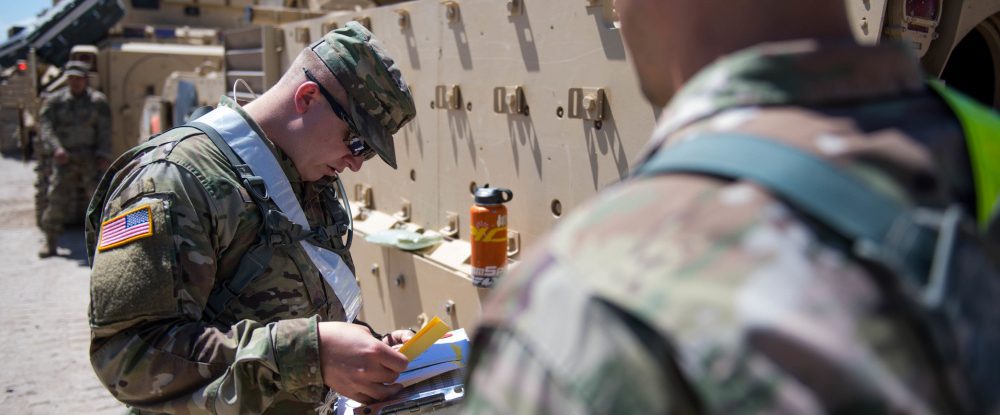
Soldiers from the Idaho Army National Guard’s 116th Cavalry Brigade Combat Team have mobilized to the National Training Center at Fort Irwin, California, to participate in a large-scale exercise. This deployment is the state’s largest since 2015.
“The National Training Center provides some of the most realistic training the Army has to offer,” said 116th CBCT commander Col. Scott Sheridan. “This gives us the opportunity to exercise our warfighting functions in a way we can’t anywhere else. 116th CBCT Soldiers have trained extensively over the past four years and are ready to demonstrate their tactical and technical proficiencies in an austere environment.”
The 116th CBCT is comprised of more than 3,000 Soldiers, with roughly 1,800 Soldiers from 137 Idaho communities and 1,200 Soldiers serving in battalions from the Montana, Nevada and Oregon Army National Guards.
Through force-on-force simulated combat operations, Soldiers will have the rare opportunity to train against a near-peer force, provided by the U.S. Army’s 11th Armored Cavalry Regiment. Soldiers will also live-fire major weapon platforms, to include the M1A1/A2 Abrams Main Battle Tank, the M2A3/M3 Bradley Fighting Vehicle, the M109A6 Paladin and the M58 Mine Clearing Line Charge.
The NTC is one of the Army’s largest combat training centers and is roughly the size of Rhode Island. Its desolate climate and varied terrain will test the brigade’s ability to sustain itself in a large and austere environment.
More than 1,000 Soldiers in Army National Guard units from eight additional states and Puerto Rico, along with three U.S. Army Reserve units, will join forces with the 116th during the rotation to complete the brigade’s combat power. In addition, the Idaho Air National Guard’s 124th Fighter Wing will provide close air support using A-10 Thunderbolt II aircraft during the 116th CBCT’s simulated combat operations.
“Everybody in this task force is a member of the 116th CBCT regardless of the patch on your shoulder,” Sheridan told senior battalion leaders Sunday during a unit movement rehearsal.
The task force comprises an additional 56 National Guard companies, platoons or sections, to include the Arizona Army National Guard’s 158th Combat Sustainment Support Battalion and the California Army National Guard’s 1st Assault Helicopter Battalion of the 140th Aviation Regiment.
The 116th CBCT last attended the NTC in 2015. The training rotation is the brigade’s capstone training event in its four-year training cycle before the unit is available to complete a real-world mission in 2020.
IDAHO ARMY NATIONAL GUARD UNIT WELCOMED HOME FROM AFGHANISTAN DEPLOYMENT

SUN VALLEY, ID, UNITED STATES
05.18.2019
Story by Capt. Robert Taylor
Soldiers from the Idaho Army National Guard’s Detachment 2, C Company, 1-168th General Support Aviation Battalion were welcomed home from the unit’s deployment to Afghanistan by Gov. Brad Little and senior Idaho National Guard leaders in a Yellow Ribbon Ceremony in Sun Valley Saturday.
More than 30 Soldiers from the unit deployed to Fort Hood in April 2018 for training and then to Afghanistan in support of Operation Freedom’s Sentinel. Soldiers began returning individually in February and the ceremony marked the first time the unit reunited since leaving Afghanistan.
“I am extremely proud of the professional service each member of this unit provides to our state and nation and very grateful that they all returned safely home to their loved ones,” said Maj. Gen. Michael Garshak, adjutant general of Idaho and commander, Idaho National Guard. “This service requires many sacrifices, not only from the deploying Guardsmen, but even more so, from their families who carry on while they are gone. We are committed to providing our Guardsmen and families with all the possible care and support as they integrate back into their lifestyles here in Idaho.”
The UH-60 Black Hawk unit provided aeromedical evacuation support for the 101st Combat Aviation Brigade in the Kandahar and Helmand providences. Throughout the deployment, Medevac crews collectively flew approximately 100 missions and more than 1,000 hours.
Soldiers worked 24-hour shifts and had 15 minutes to be in the air to respond to calls from up to 40 miles away.
“It’s an instant adrenaline rush,” said flight paramedic Staff Sgt. David Egersdorf. “There’s nothing I can compare saving someone’s life to, whether it’s an American, an Afghanistani or a foreign service member, it’s fulfilling.”
As an aeromedical evacuation unit, its UH-60L Black Hawk helicopters are equipped with defibrillators, medical fluids, oxygen tanks, medications and other advanced combat life-saving tools in addition to an external hoist system and forward-looking infrared cameras. Flight crews consist of two pilots, a crew chief and flight paramedic.
The detachment stood up in March 2017. Prior to deploying, aviators and crew chiefs had to be trained on hoist operations and other critical medevac procedures. Combat medics from other Idaho Army National Guard units were selected and trained as flight paramedics.
“In less than a year, everyone came together to help stand up the unit, learn the mission and mobilize,” said 1st Lt. Morgan Hill, detachment commander. “Not only did we go over there, do our jobs and have everyone come home in one piece, we saved lives on the battlefield. There are people alive today because of the efforts everyone put in the past two years.”
During the deployment, the unit worked closely with similar units from the Maine and Washington D.C. Army National Guards to provide medical support to coalition forces.
The Department of Defense’s Yellow Ribbon Program provides assistance to National Guard and Reserve members before, during and after deployments by connecting unit members and their families with local resources and information regarding health care, education and financial and legal benefits. Soldiers and their families attended a Yellow Ribbon event prior to the unit’s deployment and family members attended an event during the unit’s deployment.
Unit members and their families are in Sun Valley to attend a two-day reintegration program, which concludes Sunday.
This deployment marks the eighth time in the past decade an Idaho Army National Guard aviation unit deployed.
The 204th RTI claims the Idaho Governor’s Outstanding Unit Award
 05.17.2019
Story by Master Sgt. Becky Vanshur
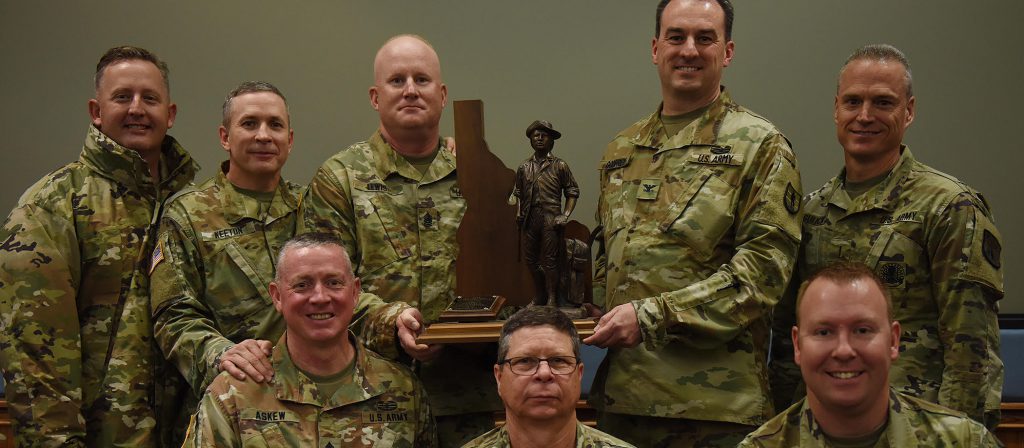
Idaho Governor Brad Little, along with Idaho Adjutant General Maj. Gen. Michael Garshak, recognized the Idaho National Guard’s top unit and several exceptional individuals in a ceremony on Gowen Field, May 17.
Little and Garshak presented the Governor’s Outstanding Unit Award to the Idaho Army National Guard’s 204th Regional Training Institute Regiment.
The regiment was recognized for aggressively directing efforts across three primary focuses of strength management, accreditation visits and supporting the 116th Cavalry Brigade Combat Team.
Additionally, the governor and Garshak presented the Idaho Distinguished Service Medal to Cheryl Miller and Cynthia Krapff, and the Idaho Meritorious Service Award to Ric Johnston and retired Chaplian Thomas Westall for their years of valuable service to the Idaho Military Division.
“This is a great opportunity to be able to recognize the impressive units we have here in the Idaho National Guard, as well as several individuals who have made notable contributions to our Soldiers, Airmen, our families and the mission,” said Garshak. “It’s always a great honor to have the governor, our commander in chief, here to make these significant presentations.”
Back to Newsroom
JOIN the Idaho Army National Guard
05.17.2019
Story by Master Sgt. Becky Vanshur
Idaho Governor Brad Little, along with Idaho Adjutant General Maj. Gen. Michael Garshak, recognized the Idaho National Guard’s top unit and several exceptional individuals in a ceremony on Gowen Field, May 17.
Little and Garshak presented the Governor’s Outstanding Unit Award to the Idaho Army National Guard’s 204th Regional Training Institute Regiment.
The regiment was recognized for aggressively directing efforts across three primary focuses of strength management, accreditation visits and supporting the 116th Cavalry Brigade Combat Team.
Additionally, the governor and Garshak presented the Idaho Distinguished Service Medal to Cheryl Miller and Cynthia Krapff, and the Idaho Meritorious Service Award to Ric Johnston and retired Chaplian Thomas Westall for their years of valuable service to the Idaho Military Division.
“This is a great opportunity to be able to recognize the impressive units we have here in the Idaho National Guard, as well as several individuals who have made notable contributions to our Soldiers, Airmen, our families and the mission,” said Garshak. “It’s always a great honor to have the governor, our commander in chief, here to make these significant presentations.”
Back to Newsroom
JOIN the Idaho Army National Guard
Idaho Army National Guard deploys to Guatemala
Courtesy Story
Idaho Army National Guard
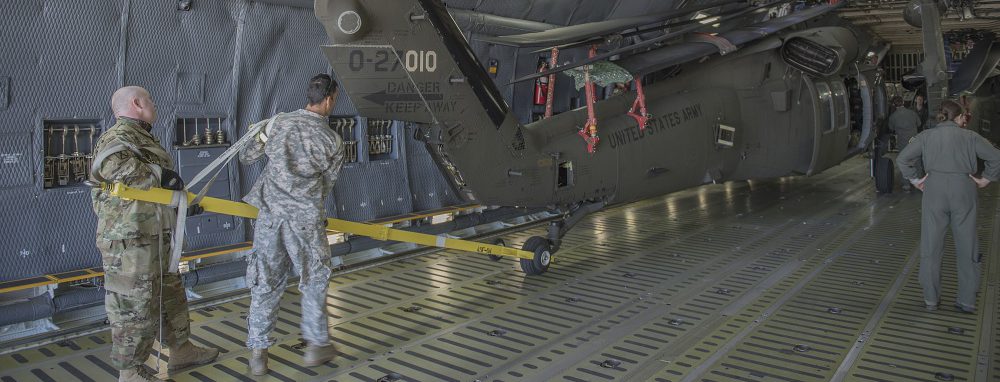
Approximately 30 Soldiers from Idaho’s 1st Battalion of the 183rd Assault Helicopter Battalion deployed to Huehuetenango, Guatemala, Sunday in support of Beyond the Horizon 2019.
These Idaho Army National Guard aviation Soldiers will spend their annual training period providing casualty evacuation support and equipment transportation for U.S. military engineers and medics as they build schools and set up medical clinics for the citizens of Guatemala from April 28 to July 27.
“This mission is an excellent opportunity for our Soldiers to deploy to a foreign country and do their jobs in an unfamiliar environment,” said Maj. Bryan Reid, the unit’s operations and training officer.
Nearly 150 pilots, crew chiefs, mechanics, petroleum specialists, signal specialists and supply personnel from the 1-183rd Assault Helicopter Battalion will rotate through Guatemala in two-week rotations.
“It is really exciting to get an opportunity to fly helicopters in a foreign country,” said 1st Lt. Colton Ankeney, the Beyond the Horizon 2019 project officer. “It will provide its own challenges and experiences that you can’t get training in the States.”
Beyond the Horizon is a U.S. Southern Command-sponsored, joint foreign military humanitarian civic assistance exercise. Hundreds of Active Duty, National Guard and Reserve members from all services will participate in the annual exercise.
The mission helps build relationships with the host nation by working with its military to improve the infrastructure and medical wellness of their citizens. Idaho Army National Guard Soldiers will receive valuable training in a deployed location to maintain their individual and unit readiness.