 Official Government Website
Category: General
Two Idaho Guardsmen earn air assault badges
Capt. Robert Taylor
Idaho Army National Guard
Two Idaho National Guardsmen graduated from the U.S. Army’s Air Assault School June 28 at Camp Rilea, Oregon. Idaho Army National Guard Soldier Cadet Porter Haux and Idaho Air National Guard Airman Senior Airman Matthew McKee completed the 10-day course to earn their air assault badges.
In addition to completing air assault school, McKee also graduated from the Army’s Rappel Master Course July 3.
“They were both good courses,” McKee said. “It was a good experience.”
McKee, a tactical air control party specialist with the 124th Fighter Wing’s 124th Air Support Operations Squadron, spent eight years in the Army Reserve before joining the Idaho Air National Guard in January 2018.
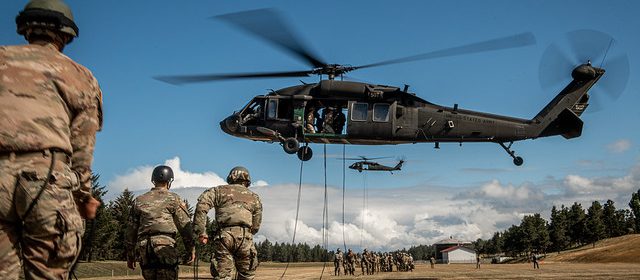
He becomes the unit’s third rappel master, which gives the squadron the required number of qualified airmen to conduct its own rappel training. The unit plans to train with the Idaho Army National Guard’s 1-183rd Assault Helicopter Battalion, which flies UH-60 Black Hawks.
The battalion’s Black Hawks supported the training courses, which included the Army’s Pathfinder Course.
Haux, a junior in Boise State University’s ROTC program, said he attended the course to become a better Soldier.
“I figured air assault course was something that I could do to better myself and further my career while doing something few people learn how to do,” he said. “I got paid to learn how to rappel from a helicopter, which is something people probably would pay a lot of money to learn how to do.”
Haux has served in the Idaho Army National Guard since November 2017. His father, Maj. Kelly Haux, is an active duty officer.
“It’s been my dream to be a Solider since I was capable of dreaming,” Haux said. “I always wanted to be a Soldier like my dad.”
The air assault course featured 10 days of instruction in three phases; combat assault operations, sling load operations and rappelling.
In phase one Soldiers and Airmen received training on combat assault, aircraft orientation, aircraft safety, aeromedical evacuation, pathfinder operations and hand and arm signals. In phase two they learned to prepare, rig and inspect various military sling-loads for equipment and vehicles such as the M998 HMMWV and M1102 Cargo Trailer. In the final phase Soldiers received instruction on tying a rappel seat, hook-up techniques, lock-in procedures, belay procedures and rappelling.
Throughout training students received several written and performance-oriented tests, conducted multiple runs and foot marches and rappelled from multiple towers and rotary wing aircraft.
Towards the end of the course, Soldiers demonstrated what they learned while repelling from a Black Hawk 90 feet above the ground.
Back to Newsroom
Join the Idaho Air National Guard
Grounded: Idaho pilots land to work with Idaho Soldiers
FORT IRWIN, CA, UNITED STATES
06.08.2019
Story by Capt. Robert Taylor
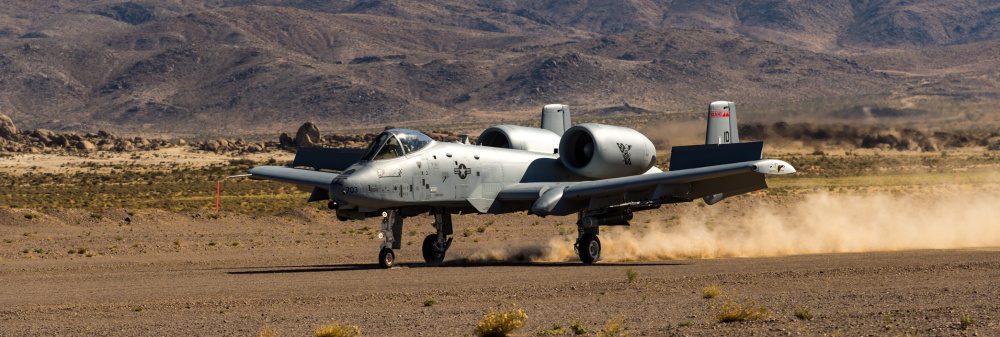
During combat operations, there’s no substitute for the ability to talk face-to-face with a supporting unit. For pilots from the 124th Fighter Wing’s 190th Fighter Squadron, this means landing their A-10 Thunderbolt IIs in a dry lake bed to discuss current operations with the 116th Cavalry Brigade Combat Team’s air liaison officer while supporting the brigade’s National Training Center rotation at Fort Irwin, California, June 4 – 9.
“We can talk about the latest conditions on the battlefield,” said 124th Air Support Operations Squadron Maj. Johnny Reyes, the brigade’s air liaison officer. “They can get the latest update on the commander’s intent for use of close air support.”
The Idaho Air National Guard’s 190th Fighter Squadron is supporting the 116th CBCT’s month-long NTC rotation through its participation in Green Flag-West 19-8, a realistic air-land integration combat training exercise. Pilots launch out of Nellis Air Force Base in Las Vegas to provide close air support to the 116th CBCT in the brigade’s fight against opposing forces provided by the U.S. Army’s 11th Armored Cavalry Regiment.
Pilots spent the week completing qualification landings on the NTC’s Freedom Landing Strip to be prepared to land in austere environments in a combat environment.
“The training gives us confidence we can do it in a combat situation if required,” said Lt. Col. “Champ” Clark, 190th Fighter Squadron commander.
Landing in austere conditions is a task the A-10 Thunderbolt II is well designed for, Clark said. The aircraft’s twin engines are placed high on the aircraft, minimizing the risk the engines could be damaged during landing. Its tires are wide and rugged. Its high ground clearance assists with landing on less-then-ideal surfaces.
“It’s the same as landing on a paved runway, but different,” Clark said. “You have to ensure you land soft and you can’t really break as much as you’d like to. The runway is a little rougher. It’s a little more challenging, so you have to be more careful.”
Once pilots land, they have the ability to communicate directly with Soldiers and Airmen on the ground, including the unit’s air liaison officer, the ground force commanders and their staffs.
Reyes, and the 190th ASOS, is aligned with the 116th CBCT. Because the 124th Fighter Wing’s and the 116th CBCT’s headquarters are located less than a mile apart on Gowen Field in Boise, Reyes is able to fully integrate into the brigade’s staff. Reyes and the unit’s joint terminal attack controllers deploy anywhere the 116th CBCT does to coordinate the use of close air support to support the brigade’s deep fight. The 190th Fighter Squadron’s participation in Green Flag-West happened to coincide with the brigade’s NTC rotation.
“It’s really cool to work with Idaho Army National Guard Soldiers,” Clark said. “Those relationships we build at home, we continue out here and take back with us.”
Rayes said it would tie up brigade communication channels for a significant period of time to communicate all of the latest updates to pilots in the sky. In addition, pilots are able to offer updates to the unit’s maps based off what they saw on their way to the brigade’s tactical operations center, which helps improves the brigade’s common operating picture.
“Pilots serve as an extension of the tactical air control party and get a lot of work done in the deep fight,” Reyes said.
The 116th CBCT’s tactical air control party consists of Reyes, more than a dozen 190th ASOS JTACs, two Marine JTACs and five members of the Brazilian Special Operations Command.
The 116th CBCT, is comprised of 3,000 Soldiers, including 1,800 from 137 Idaho communities and 1,200 Soldiers from the Montana, Nevada and Oregon Army National Guards. The unit is completing a month-long rotation at the National Training Center to build combat readiness and improve Soldier proficiency in their wartime missions. More than an additional 1,000 Soldiers from units in nine Army National Guard states are supporting the 116th CBCT’s rotation. The 116th CBCT is one of five National Guard armored brigade combat teams.
Idaho National Guard marksmanship team trains with local Treasure Valley sniper police
MELBA, ID, UNITED STATES
06.09.2019
Story by Master Sgt. Becky Vanshur
MELBA, Idaho – “Everybody wants to be a sniper, until it’s time to do the sniper stuff,” said Cpl. Brian Lueddeke, a sniper instructor from the Meridian Police Department. “It’s just what it is, right, the hard truth. We are called lizards because we are out there lying on the hot rocks baking ourselves, or we are up on a rooftop blanketed by snow in a blizzard.”
The Idaho National Guard marksmanship team participated for the first time in the urban and rural sniper training held in Melba by the Treasure Valley’s SWAT sniper element. The Meridian Police Department sponsored the course and the SWAT team instructors volunteered their time to produce the intense 50-hour, five-day course, held from June 3 through June 7.
Police officers from the Ada County sheriff’s office, Gem County sheriff’s office and Soldiers from Idaho National Guard completed their week of training with a certified qualification exam. These are essential skills necessary to operate effectively as a designated precision marksman, commonly referred to as DPM, or sniper.
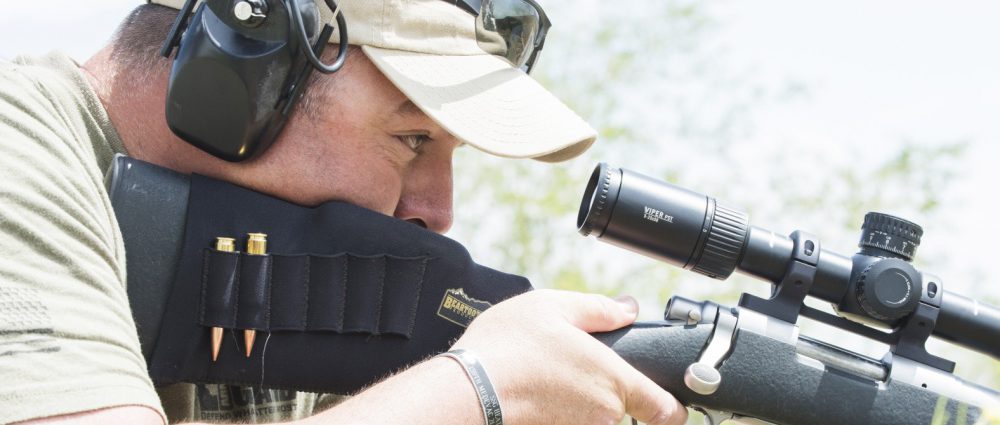
The two most essential skills learned were marksmanship and field craft. Marksmanship is engaging select targets with consistent precision fire and the use of a bolt-action scope riffle. Field craft is the ability to effectively detect, observe and report critical information to their operational command while remaining in a concealed position.
“What are some things in the urban environment that can cause us problems when we are out on a mission? Sound. Yes, but that can also be a cover,” said Lueddeke. “People. Yes, the lookie-loos. Everybody flocks to where the police are and now you have all sorts of issues in the event that you run into an immediate threat situation and need to take a shot. Vision obstruction from buildings and wind compression problems can occur more frequently in the urban environment than in a rural environment.”
As the course concluded, a sniper now has the training and discipline to research an objective and pre-select locations where they can move into undetected to observe their objective.
“Everyone sees us as just shooters but that’s not really what it is,” said Patrol Officer Travis Woodbury, from the Nampa Police Department and a volunteer sniper instructor for the course. “It is a constant surveillance roll. We are information gathers before we are anything else. For example, if we gather enough information from a reconnaissance surveillance, and report it back, it might just be enough information to issue a search warrant from command.”
The city of Melba and Melba High School graciously volunteered classroom space, building rooftops and shooting ranges in support of the joint training.
The military and the police departments across the Treasure Valley have continued to work together throughout the years in real-world missions as well as in a training scenario like this one.
“The joint relationship between the Idaho National Guard and the Police Department is great. We love them, they love us,” said Patrol Sgt. Chris Bones, an Ada County SWAT member, who is also training to be on the sniper team. “I think what bolsters that relationship is a lot of deputies are either current military or former military, and that naturally forms a common bond, especially when we get into a training environment together.”
It may be the first sniper training for the Idaho National Guard marksmanship team Soldiers, but they foresee a future of continuous joint training.
The Idaho National Guard’s 2nd of the 116th Calvary Brigade Combat Team started their sniper program just over a year ago and formed their small sniper scout platoon.
“The marksmanship team is coming out here so that we can start building the foundation for future training within our own sniper program,” said Sgt. 1st Class Jared Frogley, the IDNG state marksmanship NCO in charge. “We are heavily involved with our sniper team and I believe we are going see this type of joint training continue.”
116th CBCT arrives at the National Training Center
FORT IRWIN, CA, UNITED STATES
05.28.2019
Story by Capt. Robert Taylor
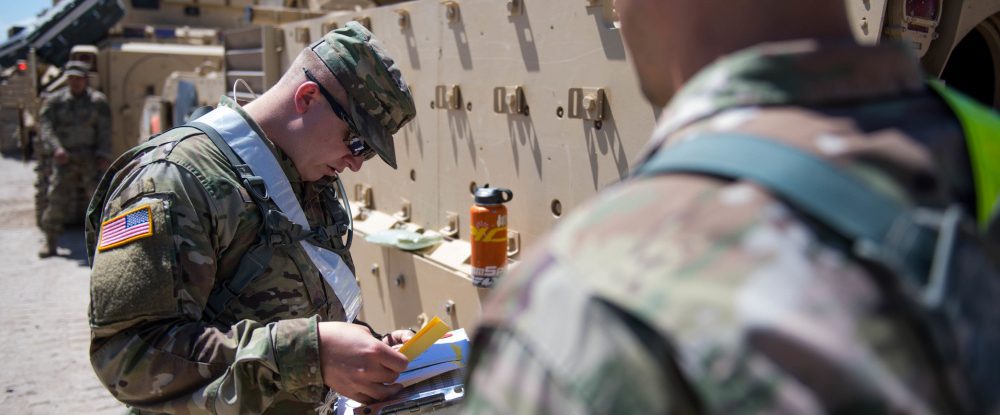
Soldiers from the Idaho Army National Guard’s 116th Cavalry Brigade Combat Team have mobilized to the National Training Center at Fort Irwin, California, to participate in a large-scale exercise. This deployment is the state’s largest since 2015.
“The National Training Center provides some of the most realistic training the Army has to offer,” said 116th CBCT commander Col. Scott Sheridan. “This gives us the opportunity to exercise our warfighting functions in a way we can’t anywhere else. 116th CBCT Soldiers have trained extensively over the past four years and are ready to demonstrate their tactical and technical proficiencies in an austere environment.”
The 116th CBCT is comprised of more than 3,000 Soldiers, with roughly 1,800 Soldiers from 137 Idaho communities and 1,200 Soldiers serving in battalions from the Montana, Nevada and Oregon Army National Guards.
Through force-on-force simulated combat operations, Soldiers will have the rare opportunity to train against a near-peer force, provided by the U.S. Army’s 11th Armored Cavalry Regiment. Soldiers will also live-fire major weapon platforms, to include the M1A1/A2 Abrams Main Battle Tank, the M2A3/M3 Bradley Fighting Vehicle, the M109A6 Paladin and the M58 Mine Clearing Line Charge.
The NTC is one of the Army’s largest combat training centers and is roughly the size of Rhode Island. Its desolate climate and varied terrain will test the brigade’s ability to sustain itself in a large and austere environment.
More than 1,000 Soldiers in Army National Guard units from eight additional states and Puerto Rico, along with three U.S. Army Reserve units, will join forces with the 116th during the rotation to complete the brigade’s combat power. In addition, the Idaho Air National Guard’s 124th Fighter Wing will provide close air support using A-10 Thunderbolt II aircraft during the 116th CBCT’s simulated combat operations.
“Everybody in this task force is a member of the 116th CBCT regardless of the patch on your shoulder,” Sheridan told senior battalion leaders Sunday during a unit movement rehearsal.
The task force comprises an additional 56 National Guard companies, platoons or sections, to include the Arizona Army National Guard’s 158th Combat Sustainment Support Battalion and the California Army National Guard’s 1st Assault Helicopter Battalion of the 140th Aviation Regiment.
The 116th CBCT last attended the NTC in 2015. The training rotation is the brigade’s capstone training event in its four-year training cycle before the unit is available to complete a real-world mission in 2020.