 Official Government Website
Category: 116th
Idaho Guardsmen take runner-up spot in Best Mapper UK 2026
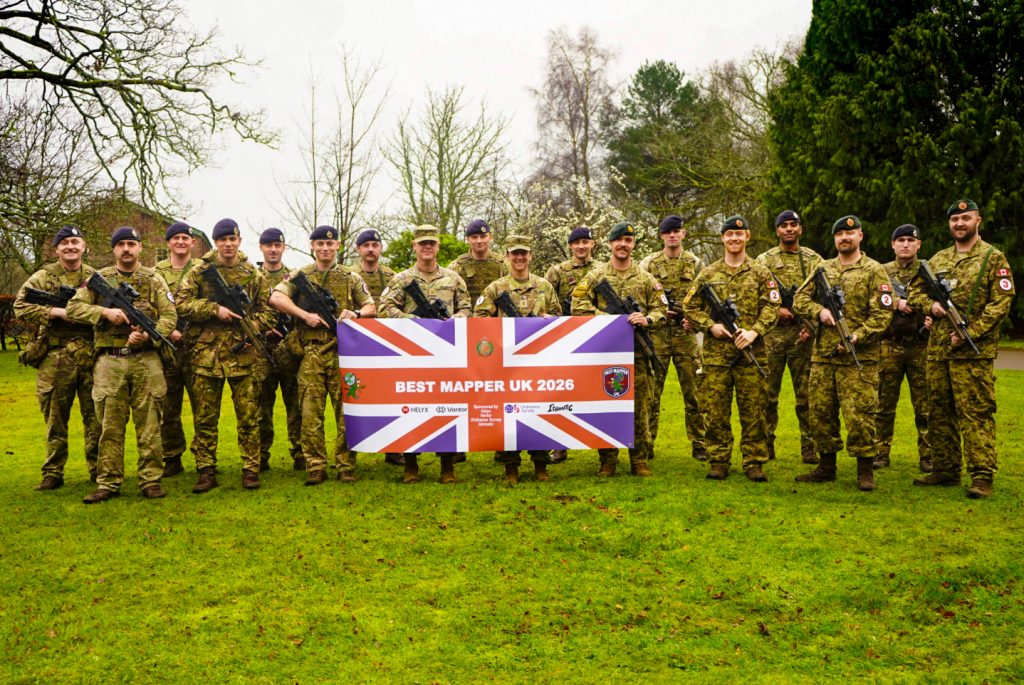
An Idaho National Guard team earned runner-up honors in the British Army’s Best Mapper UK 2026 competition held at Longmoor Camp in Hampshire, England. Maj. Benjamin Farnsworth and Chief Warrant Officer 2 Christine Smith were the only U.S. military representatives entered in the competition. They faced off against two teams from the Canadian Armed Forces and six teams fielded by the British Army. A team representing the Canadian Forces Joint Imagery Centre took top honors.
Farnsworth, military intelligence officer, said placing in the competition is coveted within this small professional community.
“For us, the main goal was really to go and represent the United States Army and the Idaho Army National Guard and the 116th (Cavalry Brigade Combat Team),” said Farnsworth. “We also tried to take advantage of the cultural immersion, especially getting to know our counterparts in the British and Canadian militaries so we could understand them better and build those relationships.”
According to Farnsworth, the Best Mapper UK is a newer offspring of the U.S. Amy’s Best Mapper competition and is designed to create an order of merit list to decide which British teams will compete at Ft. Leonard Wood. Best Mapper UK is in its second year, although this year marks the first time the British Army has sent an open invitation to allies.
In addition to tasks related to geospatial mapping, Mapper UK tests a variety of fundamental soldiering skills including marksmanship, land navigation, vehicle maintenance and physical fitness.
Smith, a geospatial engineering technician, said the challenges presented by the competition provided an opportunity to test herself personally and professionally.
“Just being immersed in that week-long training exercise where you’re never really taking a break from it is a valuable experience, and we can learn something about ourselves from being pushed to our limits,” said Smith. “I’m very grateful for the opportunity that I got to go and represent Idaho.”
Idaho Army National Guard announces Best Warrior winners
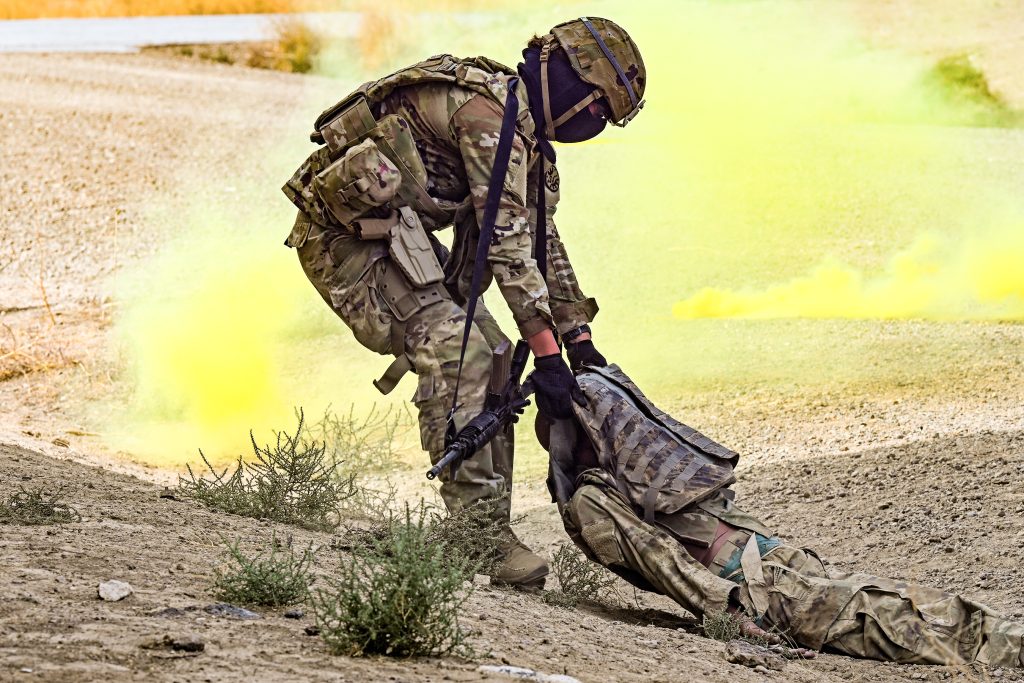
Sgt. Jake Gardiner and Spc. Tyler Barlass have been named Idaho Army National Guard’s Best Warriors after a grueling four-day competition. Gardiner won in the noncommissioned officer category, and Barlass won in the Soldier category. Both Soldiers are assigned to Headquarters and Headquarters Company, 2-116th Combined Arms Battalion.
Events included weapons assembly and immediate action drills, physical readiness testing, combatives, land navigation, tactical combat casualty care, a timed ruck, individual weapons qualification, and a culminating event.
The final event incorporated a simulated urban battle scenario that required competitors to engage live and stationary targets from separate fighting positions, clear rooms, perform basic lifesaving measures on a casualty, call for medical evacuation and deliver a casualty dummy to a helicopter for treatment and transportation.
“It was definitely challenging,” said Gardiner. “That was probably the most fun part of the competition. It was like stepping into a live video game.”
This year, 10 Soldiers competed for the title of Best Warrior. Idaho Army National Guard Command Sgt. Maj. Kevin A. Dean said nearly 200 personnel helped plan, prepare and execute the event.
“It was very well organized,” said Barlass. “It covered a lot of different skill sets, and I really liked the way they took the time to teach us some things before we were tested on each event as well. I learned a ton about weapons systems that I had never touched before, combatives and land navigation. I feel like I was really able to hone some skills and learn new things just by competing in this.”
Dean said he was impressed with both the competitors and the Soldiers who helped plan and execute the event.
“It’s very Invigorating as a senior NCO to see the caliber of Soldiers within the organization competing and the professionalism, proficiency and technical ability of those who were responsible for the individual events,” said Dean. “Seeing both the Soldiers’ and the units’ performance over those four days leaves no doubt in my mind that the future of the Idaho Army National Guard is in good hands.”
Dean said the challenges presented to the competitors helped further hone warrior skills, while testing their mental and physical stamina.
“I’m super proud of all 10 Soldiers,” said Dean. “Each won at least one individual event, and there were no dropouts or major injuries. We got to see individuals turning into a team and we all learned more about the competitors as far as their resilience, MOS, civilian jobs, and personal interests.”
“Those are some of the best people I’ve ever met in the Army,” said Gardiner. “We were competing as individuals, but everyone really helped one another every day. I’m proud of the win, but I’m prouder of the way everyone supported each other the whole time.”
Gardiner and Barlass will represent the Idaho Army National Guard against Soldiers from seven states during the regional competition in May. The event will be hosted at Gowen Field and is expected to be even more challenging according to Dean, who leads the planning team.
“I’m really excited for that competition,” said Barlass. “I have all the time I need to get fully prepared this time and I’m hoping to make it to the Nationals later this year.”
Other Best Warrior competitors included Staff Sgt. Seth T. York, Sgt. Jonathan Popocabustos, Sgt. Matthew J. Warner, Spc. Cali M. Shipman, PFC Joshua T. Dougherty, PFC Trenton S. Hawker, PFC Brent M. Rasmussen, and Pvt. Daniel A. McClymonds
Idaho National Guard OIF Vets Reunite After 20 Years
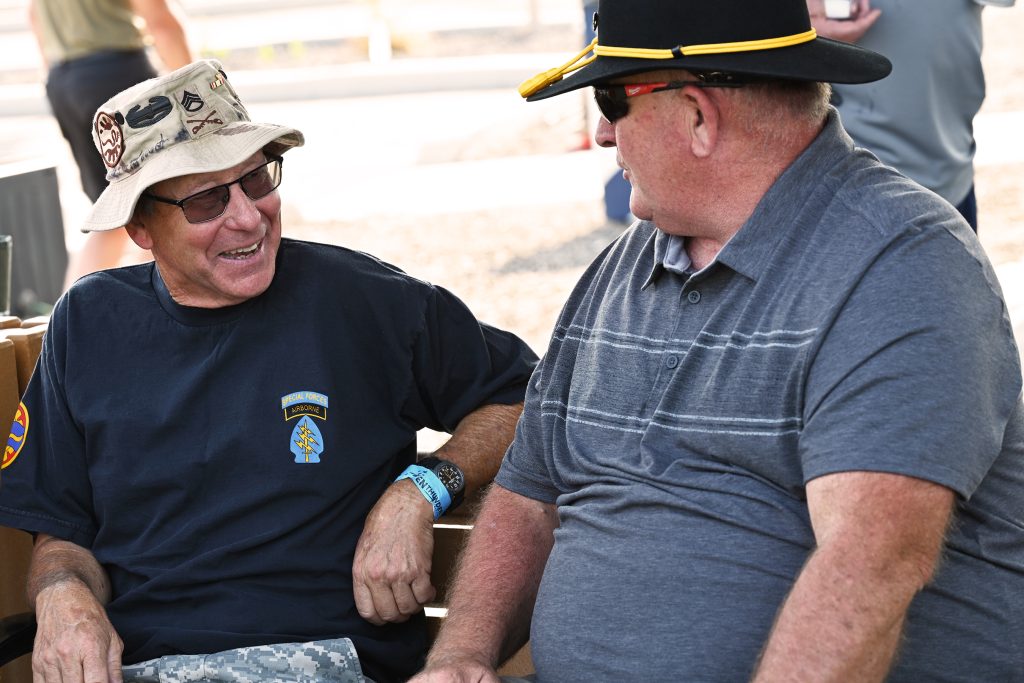
Veterans who served during the largest deployment in Idaho National Guard history gathered for a three-day 20th anniversary reunion in Boise this weekend. The weekend included battalion gatherings, a family day that included a live concert performed by the 25th Army Band and a remembrance ceremony in honor of those who made the ultimate sacrifice.
On Saturday, Dirk Kempthorne, former U.S. Secretary of the Interior and Idaho governor, was among those who addressed current and former members of the 116th Brigade Combat Team, which deployed to Iraq in support of Operation Iraqi Freedom in 2004. Kempthorne was serving his second term as governor when the unit deployed.
“To you members of the 116th, I will always be proud and inspired to stand with you,” said Kempthorne. “You have served this state with incredible bravery, courage and achievement. You have established a whole new history for Idaho about what our citizens, when called upon to serve this nation, this state and when necessary, to go to battle, will do and accomplish.”
Idaho Lt. Gov. Scott Bedke was also present, delivering a proclamation from current Idaho Gov. Brad Little to the stage declaring Aug. 10 as a day of recognition for the unit across the state.
Retired Brig. Gen. Alan C. Gayhart, who served as the unit’s commander throughout the deployment, said the unit was bolstered by Guardsmen from 15 states and included unique capabilities that were key to mission success.
“There was a reason the 116th Brigade was selected to serve in this massive area of over 10,000 square miles and three million people,” said Gayhart. “The combination of your military and civilian skills and capabilities were those needed in this troublesome area. It was clear that you were the warriors best suited to not only fight the insurgents in combat, but as citizen-Soldiers you were instrumental in the establishment of government, civic, economic, agricultural and other functions critical to peace and prosperity in this area.”
Idaho Army National Guard rescues injured hiker near Stanley
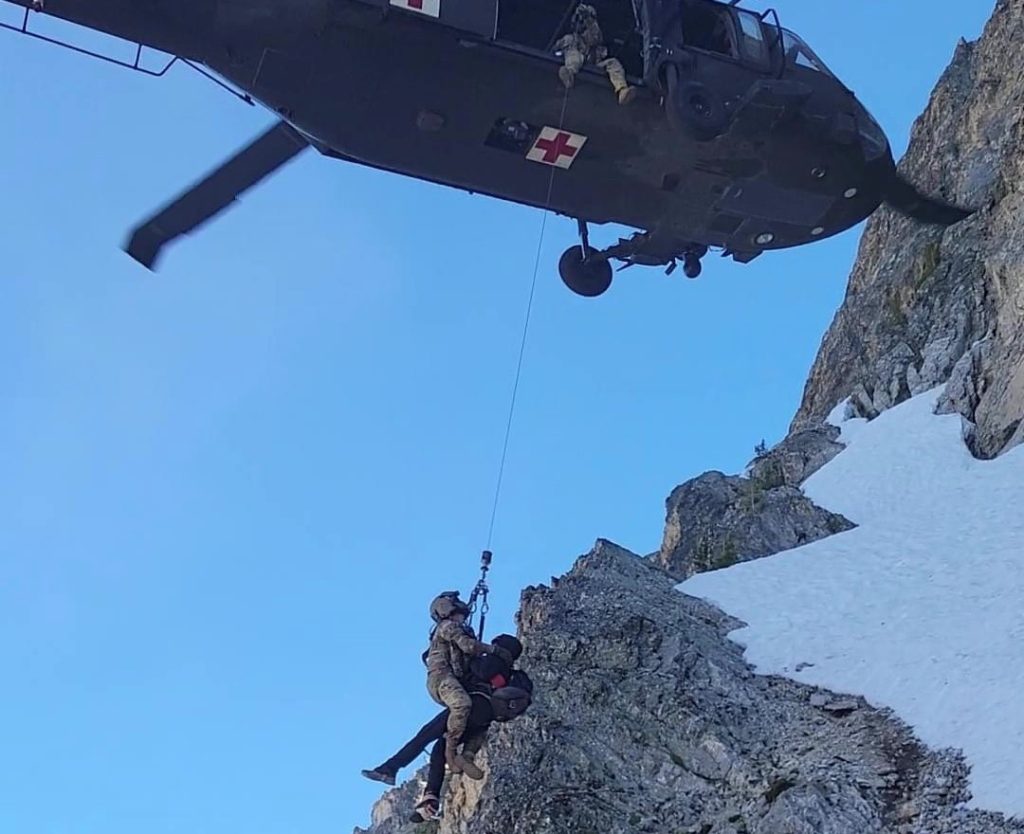
The Idaho Army National Guard’s State Aviation Group assisted Custer County Search and Rescue with the rescue of an injured hiker July 6 on Thompson Peak of the Sawtooth Range, outside of Stanley, Idaho.
The hiker, a 19-year-old male, suffered an ankle injury following a fall while rock-climbing near the mountain range’s highest peak, located approximately 75 miles outside of Boise.
“Our crew did an incredible job under some very challenging environmental conditions,” said Capt. Katherine Smith, commander of Det. 1, Company G 1st of the 168th Aviation Regiment. “The rescue required a great deal of crew coordination, as well as teamwork with the highly proficient extraction team from the Custer County Sheriff’s Office.”
The flight crew consisted of pilots Chief Warrant Officer 3 Theron Cameron and Chief Warrant Officer 3 Brennan Hoover; two crew chiefs, Sgt. Adam Brundy and hoist operator Sgt. Jessica Adamson; and one medic, Sgt. 1st Class Jared Gilstad.
The patient was initially located on a shear rock wall under a ledge. After locating him, crew members determined that there was no way to safely insert a hoist rider and extract him. The flight crew then flew to the Stanley Airport and picked up a five-person technical rope rescue team from Custer County’s search and rescue team.
“We were able to inert the team about 300 meters away from the patient using a two-wheel landing,” said Chief Warrant Officer 3 Theron Cameron, an Idaho Army National Guard UH-60 pilot.
The rescue team roped to the patient and relocated him to more favorable recovery site, where Adamson was able to lower Gilstad safely onto the ground near him. Gilstad quickly secured the patient and Adamson hoisted the pair back into the aircraft while the pilots kept the aircraft stable in challenging conditions.
“Due to the reduced power margins caused by altitude of more than 10,300 feet, the uneven terrain and the location of the extraction site, the aircrew was forced to pay extremely close attention to the aircraft limitations,” said Smith. “Lack of situational awareness in these types of situations could lead to a loss of lift or even rotor drop, requiring the aircrew to have to execute an emergency procedure to maintain stable flight.”
The flight crew transported the patient to the Stanley Airport, where he was transferred to civilian medical care.
Bolt assumes command of Alpha Company ‘Animals’
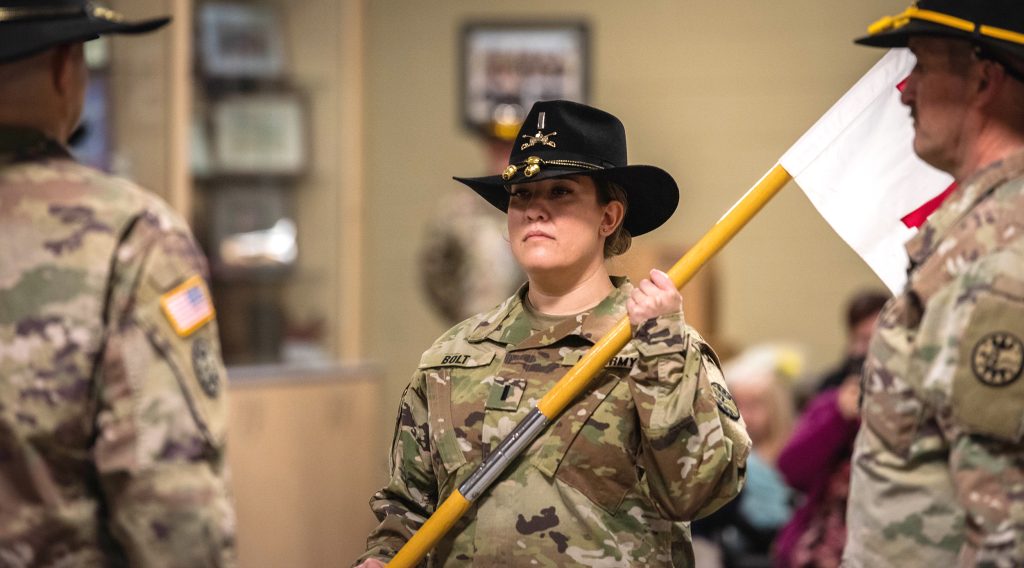
1st Lt. Lauren Bolt took her post as the commanding officer of Company A, 2-116th Combined Arms Battalion during a Feb. 26 change of command ceremony at the unit’s headquarters in Emmett, Idaho. The 2-116th is headquartered in Caldwell with units in Emmett and Nampa.
“I’m excited to be joining Alpha Company as their new commander,” said Bolt. “For the rest of this year, we have a lot to accomplish. However, I have nothing but trust, faith and confidence in the team that Capt. Edwards and 1st Sgt. Taft Bearden have built.”
Bolt, who has since been promoted to captain, relieved Capt. Arthur Edwards, who has led the unit since August 2020. Bolt enlisted in the Nevada National Guard in 2015 and initially served as a motor transport operator. She was commissioned in May 2017 as an armor officer through the University of Nevada, Las Vegas ROTC program and began her career with the Idaho National Guard as a platoon leader for Company B, 2-116th CAB. In 2019, then 2nd Lt. Bolt made Idaho history when she and fellow 2nd Lt. Brooke Berard graduated from the U.S. Army’s Armor Basic Officer Leaders Course as the state’s first two female armor officers. She has since served as the executive officer of both Company B and Headquarters and Headquarters Company. In Bolt’s most recent post she served as the battalion’s maintenance officer during its deployment in support of Operation Spartan Shield.
“I am confident in her ability to continue the Animal Company’s legacy of mission success.,” said Lt. Col. Barrett Bishop, 2-116th CAB commanding officer. “I was the battalion executive officer when Lauren was a new platoon leader, and she has developed herself well in Army competence and personal tact.”
The Army opened combat arms jobs to female Soldiers in 2015. Over the past decade, Idaho National Guardsmen have transitioned into career fields not previously open to them or reached new heights in their fields while continuing to ensure the organization remains “Always Ready, Always There” to respond to emergencies at home and abroad.
In 2014, Maj. Kimberly Tschepen became the state’s first female Soldier to command a battalion when she took command of the 145th Brigade Support Battalion and Command Sgt. Maj. Linda Burkhart became the state’s first female command sergeant major in 2015.
In 2015, Idaho Guardsman 1st Sgt. Erin Smith became the first female enlisted Soldier in the nation to graduate from M1 Armor Crewman School. Following her, Staff Sgt. Kylene Huerta completed the same course and became the first female Soldier to be assigned to the 116th CBCT as a tank crew member.
In 2017, Sgt. 1st Class Melanie Galletti graduated from the U.S. Army’s Infantryman Course as the Idaho National Guard’s first qualified female enlisted infantry Soldier. That same year, Col. Lora Rainey was appointed as the state’s first female staff judge advocate.
In 2019, 2nd Lt. Jessica Pauley became the state’s first female infantry officer.
Edwards’ departing remarks focused on reminding Company A Soldiers of their accomplishments and the pride he felt as their commander over the past two years.
“From day one, I have been beyond impressed with the professionalism and dedication of Alpha Company Soldiers,” said Edwards. “We have supported local and national callings, all while being part of an all-volunteer force … and I could not be prouder of serving alongside those volunteers.”
Total Force: Army, Air, Navy train together in mass casualty combat exercise
Master Sgt. Becky Vanshur/Idaho Military Division Public Affairs
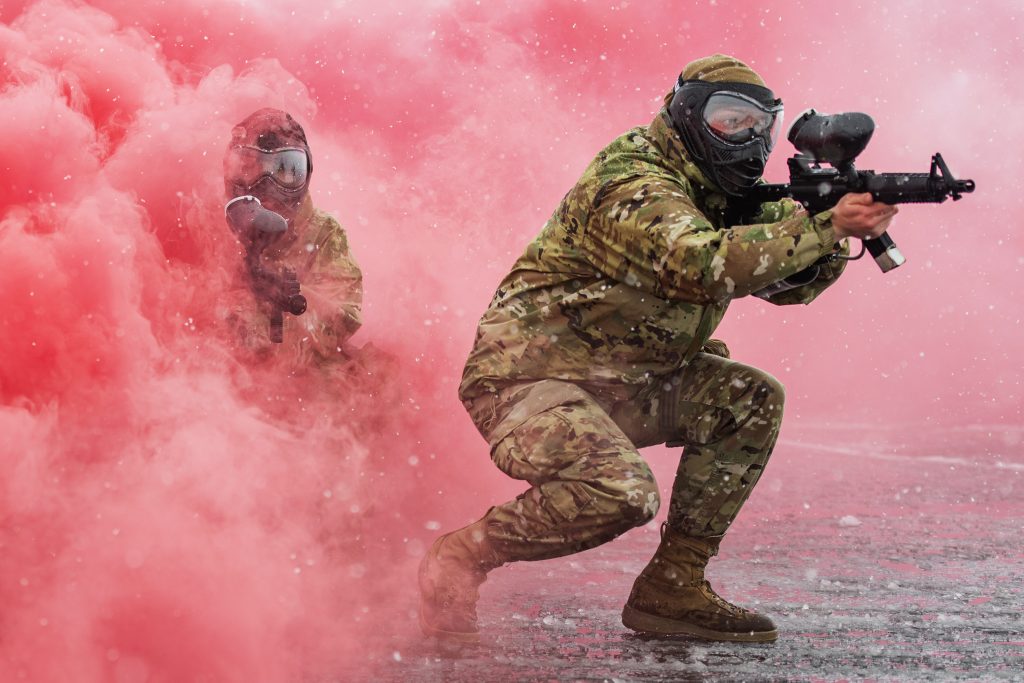
BOISE, Idaho – A deep breath in, deep breath out. An Airman from the Idaho Air National Guard holds his weapon steady in front of him, pressing it against his shoulder, finger on the trigger, his body low to the ground. He takes a small, strategic step into the plume of smoke swirling around him. Surrounded by a blanket of red smoke makes it hard to see his battle buddy but he knows his counterpart, a Soldier from the Idaho Army National Guard’s Medical Detachment, is close behind him.
The red smoke is used to conceal the medical team’s movements as they defend their medical structures and personnel who are being ambushed while conducting Tactical Combat Casualty Care on the battlefield. The two Guardsmen were among approximately 200 Idaho National Guard Soldiers, Airmen and their active duty and Navy Reserve counterparts who joined forces for a mass casualty combat exercise, Feb. 1-4, near Gowen Field.
“The main focus of this joint services training was to all come together, learn each other’s jobs and create multi-capable Soldiers, Airmen and Sailors on top of learning how to respond in mass casualty scenarios,” said Senior Master Sgt. Davis Nguyen, the 124th Medical Group function area manager. “Equally important, was the ability to perform medical care while under mental and physical stress.”
The Idaho Air National Guard’s Critical Care Air Transport Team, the ground surgical team and other medical personnel from the 124th Medical Group conducted the exercise with the Idaho Army National Guard’s Charlie Company, 145th Brigade Support Battalion Medical Detachment and medevac Soldiers from the 1st of the 168th Aviation Regiment; the Navy Operational Support Center; and active duty Airmen with the 366th Medical Group from Mountain Home Air Force Base.
During the exercise, Soldiers, Airmen and Sailors learned each other’s roles on the battlefield and in the sky. The Idaho Army National Guard’s State Aviation Group incorporated UH-60 Black Hawk helicopters and pilots who responded to 9-Line medevac requests, transporting critical care patients with CCATT officers and medevac Soldiers who stabilized them onboard while flying through simulated combat zones until they reached a higher echelon of care.
“All of our pilots need to practice this piece of the exercise and learn how to fly with patients in the back,” said Chief Warrant Officer 3 Theron Cameron, instructor pilot and medical evacuation officer from the 168th Aviation Regiment. “We need to learn the CCATT’s language to know if they are in the middle of performing a procedure as it cues us to fly as smoothly as possible through the combat areas, while communicating back that we may need to aggressively maneuver around danger.”
Airmen from the 124th Fighter Wing’s Security Forces provided combat lessons on defense and protection, 360-degree security, care under fire and tactical movements with red smoke concealment.
Colin Yates, an Idaho Peace Officers Standards and Training instructor specializing in wounds and trauma for tactical medicine, created realistic wounds on 124th Fighter Wing’s Student Flight role players acting as casualties for a more real-world training experience of TCCC on the battlefield.
Sailors from the NOSC provided the medical logistics support for the simulated deployment location, while learning from both Army and Air medics on tactical field care, casualty evacuation and Roles 1-4 medical care facilities.
“It’s anticipated in future conflicts, there will be a lot more integration with forces. We need to interact with each other and speak each other’s languages,” said Maj. Mark Urban, CCATT physician. “This exercise was developed with that in mind, being able to integrate is really key to that Total Force concept.”
One team, one fight: Army and Air join forces for mass casualty, medevac training
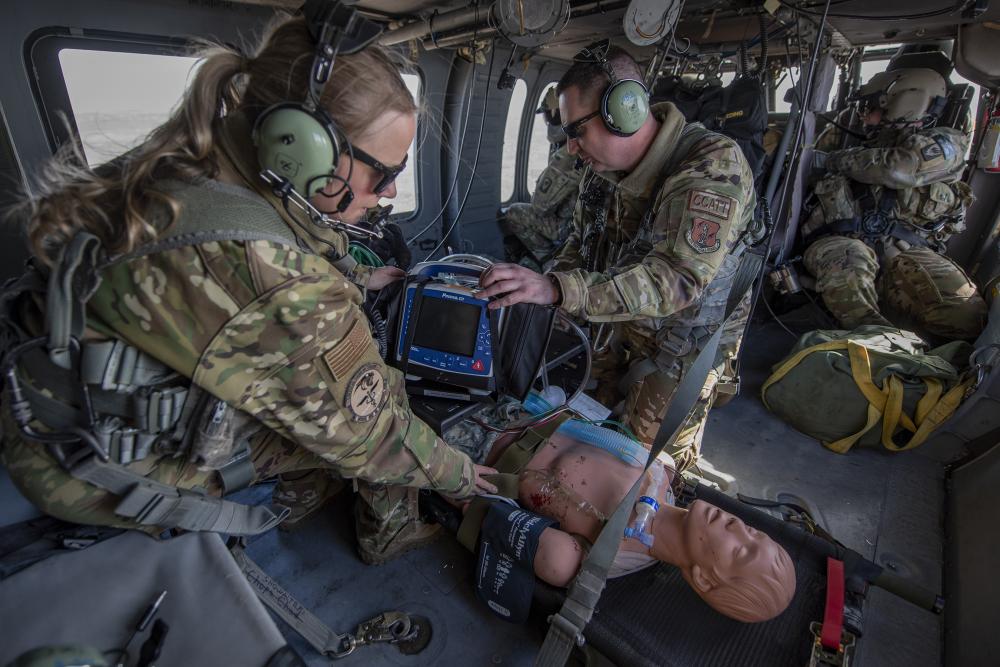
Idaho National Guard Soldiers and Airmen, as well as active duty counterparts joined forces with a one-team, one-fight mentality for joint training during a mass casualty exercise on Feb. 4 near Gowen Field.
“The best way to grow our mindset of becoming more operational and ready for a deployed environment is to train with the nearby resources, such as the Idaho Army National Guard and our active duty counterparts,” said Senior Master Sgt. Virginia Holmgren, a respiratory therapist from the Idaho Air National Guard’s 124th Medical Group. “Forming relationships with the other branches helps us to become familiar with each other’s capabilities and to practice working together because when we are in a deployed environment we will be working with the other branches in the fight.”
Medical personnel from Gowen Field’s 124th Medical Group and active duty medical personnel with the 366th Medical Group from Mountain Home Air Force Base teamed up for several mass casualty events, which also included the use of medevac Soldiers and UH-60 Black Hawk helicopters from the Idaho Army National Guard’s 1st of the 168th Aviation Regiment to participate in the medical evacuation scenarios.
“This exercise is a great example of how the Idaho National Guard is committed to the joint warfighting doctrine in support of the National Defense Strategy,” said Brig. Gen. Tim Donnellan, Idaho Air National Guard commander. “The 124th Medical Group coordinated this incredible training using combat proven units from the Idaho Army National Guard, the Idaho Air National Guard, and the Gunfighters of the 366th Fighter Wing.”
During the scenarios, combat medics performed treatment and stabilized casualties at a field medical tent in a simulated deployed location. The focus for the combat medics during the mass casualty scenarios was an emphasis on Tactical Combat Casualty Care. The TCCC is the military guideline for trauma life support in pre-hospital combat medicine, designed to reduce preventable deaths while continuing to maintain operation success.
“With our new DoD guidelines for the TCCC, it requires us to have more hands-on deck and for more Airmen to be familiar with trauma care in responding to worse injuries out on the field rather than the typical self aid and buddy care that we have focused on in the past,” said Senior Master Sgt. Davis Nguyen, the 124th Medical Group Function Area Manager.
Once medics respond and stabilize casualties, they could then recognize the patients that needed more advanced critical care at a hospital outside of the combat field location and the 9-Line medevac call requesting the Black Hawk medevac team was made. In combat, the 9-Line is an emergency medevac request with an accurate report of combat injuries that is often the difference between life and death.
The ground combat medics and the Black Hawk flight medics worked together to stabilize the casualty during flight until they reached the simulated higher echelon of medical care.
Additional scenarios required protective gear to be worn during a chemical, biological, radiological or nuclear event while Idaho National Guard Soldiers conducted hoist rescue training, allowing Airmen the chance to gain insight into a full range of rescue capabilities of the medevac Soldiers.
“I am proud of the commitment of the men and women in this joint, total force exercise demonstrating the incredible talent and the first class training capabilities we have here in Idaho,” said Donnellan. “We will continue to maintain our readiness for the immediate fight while preparing for any conflicts of the future.”
Idaho Soldiers return home from overseas deployment
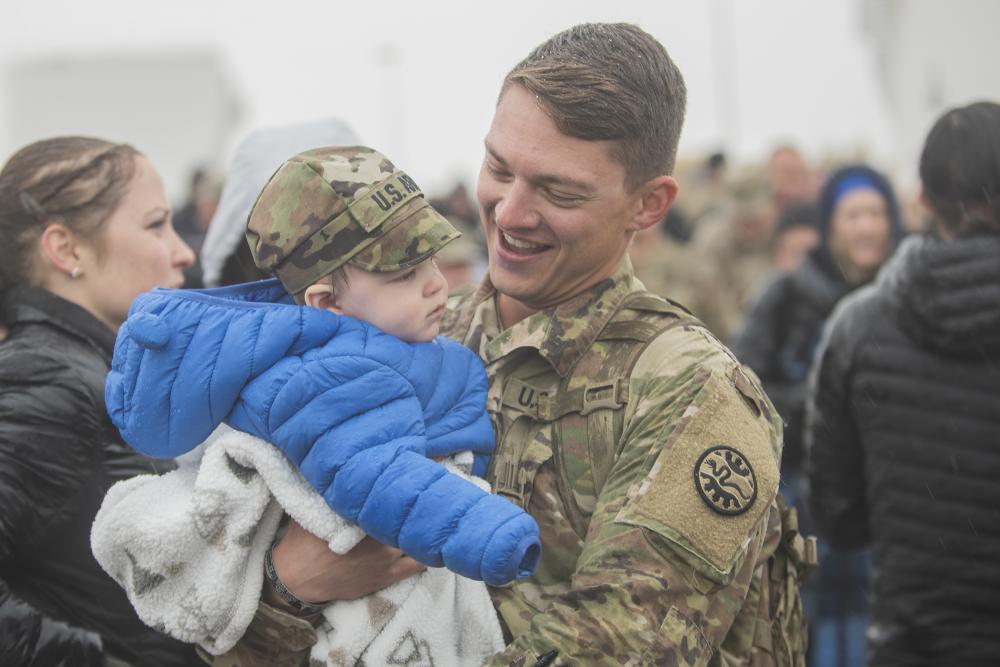
The Idaho Army National Guard welcomed home to Boise, Idaho, nearly 100 116th Cavalry Brigade Combat Team Soldiers on Nov. 4th after a yearlong deployment to Southwest Asia in support of Operation Spartan Shield. An additional 100 other Soldiers returned to their communities elsewhere across the state throughout the day.
“These Soldiers embody what the National Guard is all about: citizen-Soldiers who serve their nation when called upon and return home to their families and communities,” said Brig. Gen. Farin Schwartz, commander, Idaho Army National Guard. “It’s an honor to welcome these Soldiers home and I thank each one of them for their service and dedication to our state and nation. For 10 months, our Soldiers deterred enemy aggression in a very hostile environment, symbolizing our nation’s commitment to our global partners and allies.”
The Soldiers deployed in November 2021 to support the 116th Cavalry Brigade Combat Team’s Task Force Griz, which was headquartered by the Montana Army National Guard and included Soldiers from the Idaho, Montana, Florida and Nevada Army National Guards.
Idaho Soldiers comprised nearly 20 percent of the task force, which spent 10 months overseas, in addition to receiving 45 days of training stateside before deploying.
OSS is a joint mission under the United States Central Command and is part of Operation Enduring Freedom. The task force provided three mission response forces to the CENTCOM commander and conducted missions and training exercises in Iraq, Jordan, the Kingdom of Saudi Arabia, Kuwait, Syria and Qatar.
The task force conducted security and stability operations and demonstrated the U.S.’s continued commitment to deterring adversaries while supporting regional allies. The task force was relieved in October by another 116th CBCT-led task force, including more than 600 Idaho Soldiers, who are expected to return next year.
Task Force Griz Soldiers began returning to Fort Bliss, Texas, Oct. 24 and conducted demobilization activities before returning home.
The 116th CBCT previously deployed in support of the Global War on Terror in 2004 and 2010 to Iraq.
Idaho National Guard develops fiscal wellness through finance counseling
Crystal Farris/Idaho Military Division Public Affairs
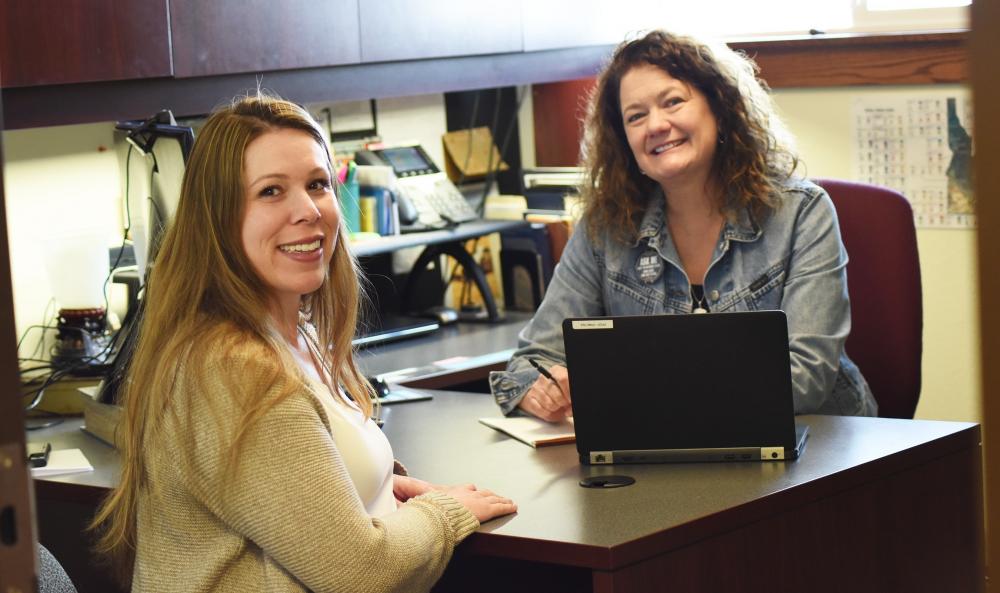
Capt. Ashley Thropp, who serves as a behavioral health officer for the Idaho Army National Guard and a clinical social worker for the U.S. Department of Veterans Affairs, always knew how to earn money, budget and save.
She joined the military when she was 17, always lived below her means and ate bean and cheese burritos while earning her undergraduate degree because they were cheap and easy.
Although she still lives below her means now, it was only after having her son two years ago, that Thropp realized she didn’t understand the first thing about investing.
At that time, Thropp decided to meet with one of the Idaho National Guard’s financial counselors to learn ways to invest her money, set herself up for a better retirement and plan for her son’s future.
“I just had my son and was working from home at the time,” said Thropp. “My unit had put out information about free financial counseling and I wondered if the counselors could answer some questions about how my family could make better financial choices for our future.”
Financial counseling services
The Idaho National Guard’s financial counselors help with tax assistance, offer support and counseling opportunities for credit management and provide training in money management, budgeting and home buying. They also help service members in reaching long term goals, such as emergency savings, education, buying a house and retirement.
“Just like we need to see a medical professional for our annual check-ups, it’s a good idea to see a financial professional to ensure a financial fit future,” said Jennifer Wood, a personal finance counselor with the Idaho National Guard.
Statistically, Wood said financial issues are reported in the top three areas where service members struggle the most. Since a service member’s financial problems affect their military readiness, the Idaho National Guard provides free financial counseling and services through Accredited Financial Counselors, like Wood, who are available to all branches of the military, their family members, Gold Star families and veterans within 180 days of transitioning out of the military.
Initial financial appointments take approximately an hour and can be conducted in person, over the phone or by video conference. During that time, a financial counselor will get to know a person’s financial situation, gather information and develop a plan forward.
“Together we identify where they are and where they want to be financially in the future,” said Wood. “Setting future financial goals gives the client somewhere to allocate money. The goals are identified, labeled and achieved by monthly allocations.”
Making a return on her investment
During Thropp’s visit with the financial counselor, she said they discussed the five basic TSP funds, the Lifecycle funds and how Thropp felt about investment risk.
“The financial counselor talked me through each of the different TSP funds, how they work and about risk tolerance,” said Thropp. “I learned how choosing a different fund could mean I take more risk with my investment, but the gain is significantly better. She also helped me come up with some investment percentages that I was comfortable with and that made sense to me.”
After her meeting with the financial counselor, Thropp chose to move her TSP funds from the G fund to more aggressive C and S options. Thropp said she is pleased that her retirement investment grew after only several months.
The Thrift Savings Plan is the federal government’s sponsored retirement plan for employees, which all military service members are eligible for. Although she has been contributing 15 percent of her Guard earnings since 2005, Thropp never accessed or managed her money in the TSP and was therefore defaulted to the G option, which Wood describes as a glorified savings account.
“I didn’t understand risk tolerance and investing before meeting with the financial counselor,” said Thropp. “I didn’t understand the G fund only grew by very small percentages, compared to the C and S funds, which move with the market and have already grown significantly since I made the switch. I just wish I would have known about the benefits of contributing to different funds earlier.”
In addition to TSP investment opportunities, Thropp learned the importance of other investments, standalone mutual funds and investing in her children’s education through a 529 Education Account. The 529 account is an education investment account, offered in every state, that within Idaho also offers a state tax advantage.
Wood said the money in a 529 accrues much of the same way the TSP does, except it can only be used toward all qualified education expenses, including K-12 schooling and expenses such as tuition, books and school supplies.
“I learned that the 529 plan moves with the market and grows more over the years than it would through a savings account,” said Thropp. “The financial counselor showed me a graph of how the market has grown over the last hundred-year period. I opened mine last year, contributing $50 a paycheck in the market investment. So far, I’ve invested $1,750 of my own money and it’s already at $2,600.”
While different TSP options and a 529 were the best fit for Thropp, financial counselors are able to provide information and options to service members and their families based on individual needs.
All investments have risk, Wood said, and the amount of risk one is willing to take is the amount of return an investor should expect to see.
“Not everyone is in a position for a high-risk, high-reward investment,” said Wood. “That is why I recommend investing in mutual funds vs. stock instruments for beginning investors. I realize block chain currency, like Bitcoin, is a flashy and exciting way to invest, but it is also risky. I’ve seen service members who live paycheck to paycheck invest in cryptocurrency hoping to make a windfall return, only to lose money in the end. Investing slow and steady is the best way to gain wealth.”
For Thropp, she said her goal was to contribute as much as possible now toward her retirement, while she is still young and able to afford taking higher risks with her investments.
Grateful for Guard benefits
“In past years, I think I may have taken for granted the services and benefits we are offered as Guardsmen, like the free financial counseling,” said Thropp. “I can easily call or set up a video chat with a financial counselor. Other people don’t have that and when I look at it from that perspective, I realize how amazing it is to have these benefits at my fingertips and I try to share that knowledge with others.”
Thropp said she encourages other Guardsmen to invest in their TSPs and meet with a financial counselor about their retirement and investment opportunities to help prepare them for their futures.
“I pass that information on because I wish I would have known it myself early on,” said Thropp. “The Guard has so many opportunities and benefits available to us, if we only take advantage of it. I’m very grateful for the Guard and what it has provided me over the years to grow and improve my life both personally and professionally.”
Beside financial services, the Idaho National Guard’s Service Member and Family Support program also offers referral resources for crisis intervention, legal resources, TRICARE resources, emergency family assistance, community information and outreach and financial services.
Visit https://www.imd.idaho.gov/personal-finance-counseling/ and https://www.imd.idaho.gov/idaho-national-guard/family-programs/ for more information.
Idaho Army National Guard Soldiers prepare for deployment
Maj. Robert Taylor/Idaho Military Division Public Affairs
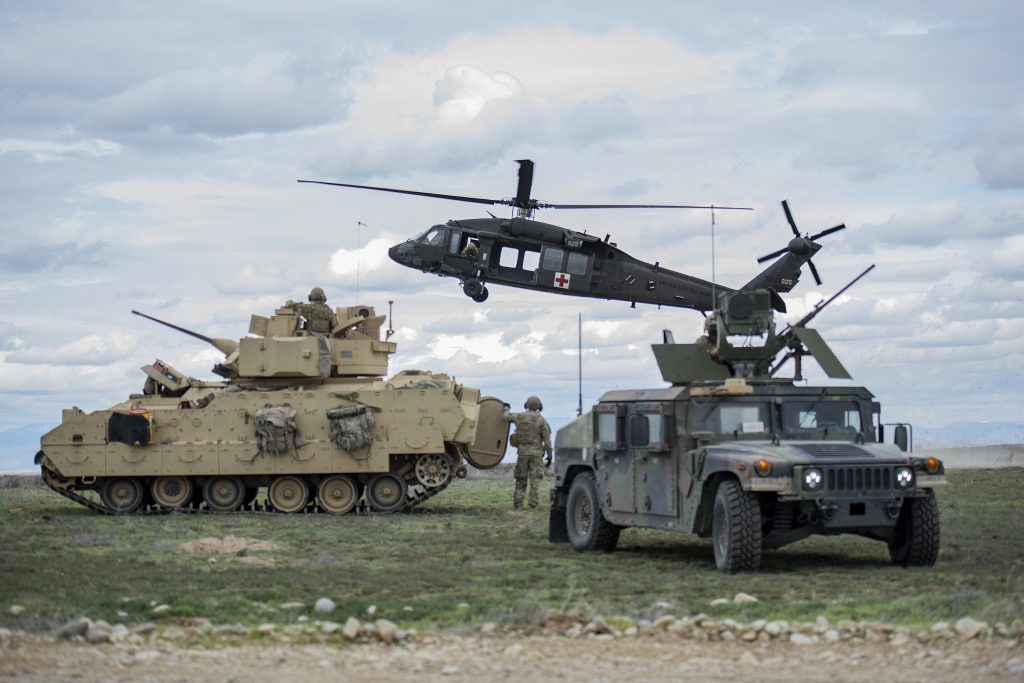
The 2nd of the 116th Combined Arms Battalion conducted an extended drill period March 24 – April 1 at the Orchard Combat Training Center to build team proficiency prior to deploying in support of Operation Spartan Shield later this year.
“The battalion did a phenomenal job coming together as a team,” said Maj. Sam McDowell, 2-116th CAB commander.
M1A2 Abrams and M2A3 Bradley Fighting Vehicle crews conducted Table VI crew qualification tables and will build off their crew-level proficiencies to conduct platoon qualifications at annual training in May prior to mobilization and conducting a combined arms live-fire exercise at Fort Bliss, Texas.
The unit took advantage of several of the OCTC’s 23 training ranges to conduct individual weapon qualifications, crew-served weapon qualifications, a staff exercise, sniper training, Javelin firing and mortar training to Table III.
The battalion also teamed up with the Idaho Army National Guard’s 1st of the 183rd Assault Helicopter Battalion to conduct medevac and combat search and rescue training as well as air insertion missions on a simulated village located within the OCTC.
More than 700 116th Cavalry Brigade Combat Team Soldiers, comprising a task force led by the 2-116th CAB, will deploy to Southwest Asia for approximately 12 months in support of OSS later this year. OSS is a joint mission under the United States Central Command and is part of Operation Enduring Freedom.
The task force will relieve Task Force Griz, which is currently performing the same mission. Task Force Griz is led by the 116th CBCT’s 1st of the 163rd CAB and consists of Soldiers from the Idaho, Montana, Nevada and Oregon National Guards as well as augmentees from the Florida National Guard. More than 20 percent of the current task force is made up of Idaho Army National Guard Soldiers.
“The Soldiers of the 116th CBCT are training hard and will be prepared for this mission when they deploy,” said Lt. Col. Eric Orcutt, 116th CBCT commander.
The 116th Cavalry Brigade Combat Team previously deployed in support of the Global War on Terror in 2004 and 2010 to Iraq. Idaho National Guard personnel have been supporting the state of Idaho throughout the COVID-19 pandemic since 2020 and assisted the Idaho Department of Lands battle wildfires across the state last summer. Additionally, more than 400 Idaho Air National Guardsmen deployed to Southwest Asia in the summer of 2020.