Official Government Website

The Department of Defense is using integrated primary prevention to inhibit multiple harmful behaviors–including sexual assault, harassment, domestic abuse, child abuse, and suicide that impacts readiness & retention. Research shows these behaviors share similar risk and protective factors. By focusing on shared factors, IPPW will foster healthier command climates, leading to enhanced readiness and a greater ability for Service members to execute critical missions. To learn more about the Department’s integrated prevention strategy, review the DoD Prevention Plan of Action 2.0.
With support from Leadership, the IDNG IPPW Team supports coordination of three planning requirements: the DEOCS Commanders Action Plan (CAP), the Unit Risk Inventory and Risk Mitigation Plan (URI & RMP) recommendations and the Comprehensive Integrated Primary Prevention Plan (CIPP) – into a bigger picture snapshot for Leadership that will be monitored and has ongoing evaluation.
Through this streamlined process, the IPPW team helps to facilitate a shift in perception and enhanced understanding, ultimately showing leaders how the Command Climate Assessment provides additional valuable indicators outside of DEOCS survey data. This short-term impact further supports a greater understanding of how action plans can be implemented using a focused and data-driven approach.
Beginning in TY26, the IDNG will move to a two-year DEOCS cycle. The next survey fielding window will open 01 August – 30 November 2026. In year one of the biennial DEOCS cycle, the DEOCS will be administered with a survey window of 1 Aug – 30 Nov, in alignment with the timeline followed nationally. The output from the DEOCS is the Commanders Action Plan (CAP). In year two of the biennial DEOCS cycle, units will focus on continued implementation of their CAP while IPPW focuses on supporting CAP implementation and collecting additional data via observations, sensing sessions and record reviews, etc. TY25 was year one of this cycle, and TY26 will be year two.
How Can We Help?
A supportive culture of prevention refers to the organization’s readiness to address harmful behaviors through a preventive rather than reactive approach. Leaders can promote a culture of prevention by:
- Encouraging healthy habits, empathy, communication and help-seeking
- Cultivating values of unit cohesion and connectedness.
- Embedding resiliency strategies at all levels within the IDNG.
We help the Idaho National Guard by:
- Establishing an adaptive, integrated prevention system to reduce harm
- Strengthening cohesion across the force
- Adding dedicated and trained resources to support the National Guard prevention system
- Ensuring the prevention process is data-driven and expert-led
We can provide training and information, including:
- Helping leaders build healthy climates and create environments free from abuse and harm
- Developing life skills
- Resisting peer pressure
- Developing problem-solving skills
- Learning about healthy relationships
- Strengthening access to financial support
- First -Line Leaders Course
- Total Health Workshops
- Other CARES Model components


Integrated Primary Prevention Manager
Todd Stevens, 208-272-8303, todd.m.stevens10.mil@army.mil
Integrated Primary Prevention Leads (Data Crunchers and Analysts)
Brianne Thelander, 208-270-8311, brianne.m.thelander.civ@army.mil
Aaron Blake, 208-272-8307, aaron.m.blake.civ@army.mil
Primary Prevention Specialist (Unit Level Information Gatherer & Support Staff)
Christina Cernansky, 208-272-8312, christina.r.cernansky.civ@army.mil
Morgan Proud, 208-272-8315, morgan.c.proud.civ@army.mil
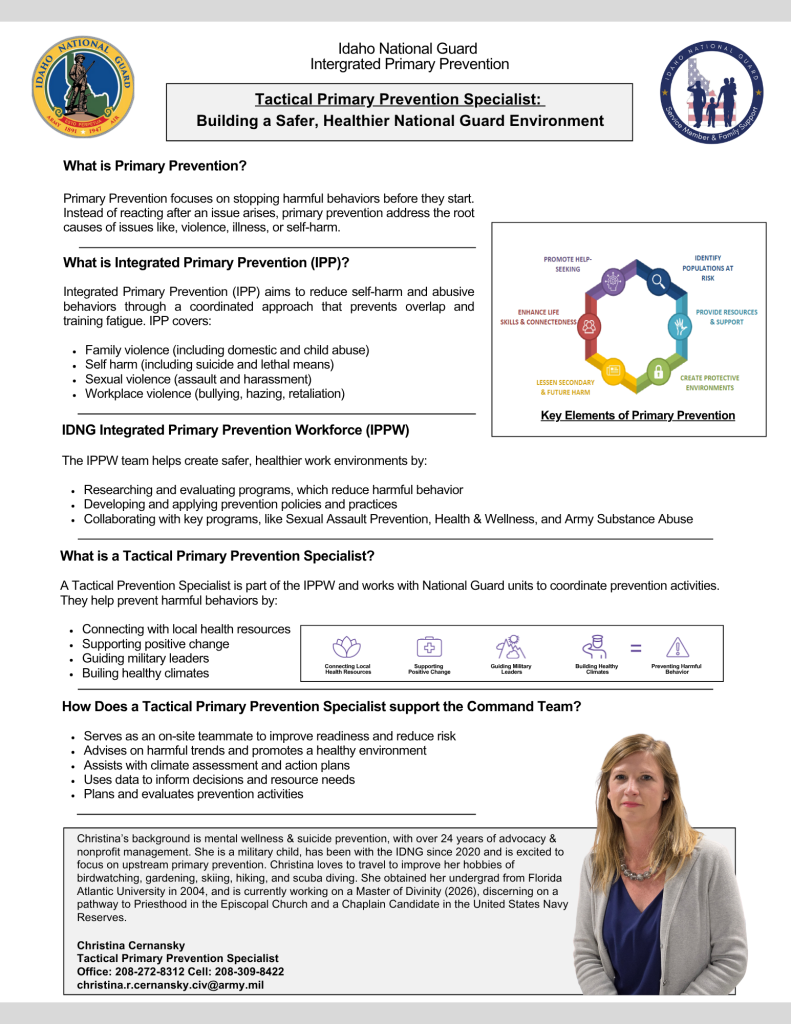
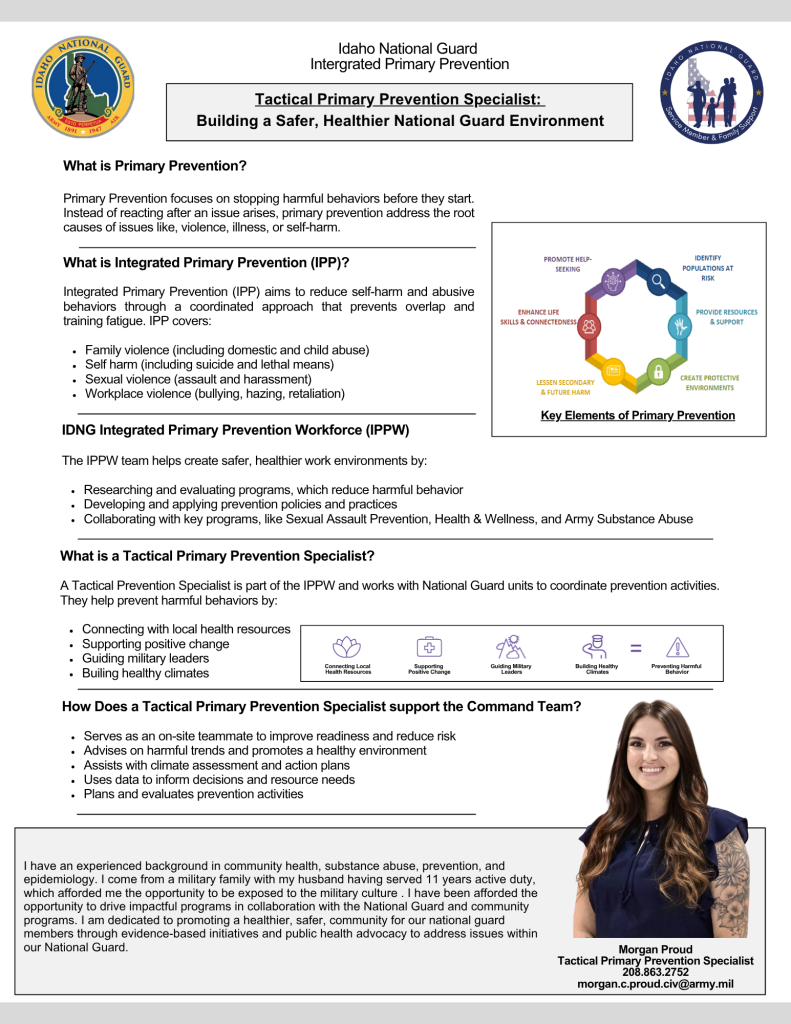
Tactical Prevention Specialists across the state of Idaho collaborate with the command team and leaders at all tactical levels to provide resources and education on harmful behaviors and mitigation, including:
- Suicide
- Substance Misuse
- Harassment
- Sexual Assault
- Domestic Abuse
- Child Abuse
We’ll equip you to deliver informed prevention messages in formal and informal settings, enabling you to have a respectful conversation and foster unit cohesion, retention and overall wellness in your unit. The TPSs can also support your TNCOs/RNCOs as support staff, to help mitigate stress, embed strategies to support readiness & retention.
DEOCS FAQs
All Service Members and civilian employees in command or organization must have the opportunity to participate in the Command Climate Assessment (CCA). Contractor personnel may not participate in the CCA, according to DoD policy. If everyone in a unit participated in the DEOCS, the results would accurately reflect everyone’s views. Not every unit member will take the DEOCS – the average response rate for Navy units is 40%. Therefore, the DEOCS results reflect the views of those personnel who chose to participate in the survey. Still, with the right information, it is also possible to estimate where the actual results for all personnel are likely to fall.
This is where confidence intervals and margins of error can be helpful. The table below shows how many people a command needs to participate, based on unit size, to be 95% confident, the result reflects the population within a Margin of Error (MOE). As an example, if the command has 150 personnel and at least 108 participate in the DEOCS, then the command can be 95%confident that the DEOCS results will be within +/-5% of the actual results if all 150 had taken the DEOCS. The MOE provides the upper and lower boundaries within which the actual value falls

A Comprehensive Resource for DOD Climate Surveys
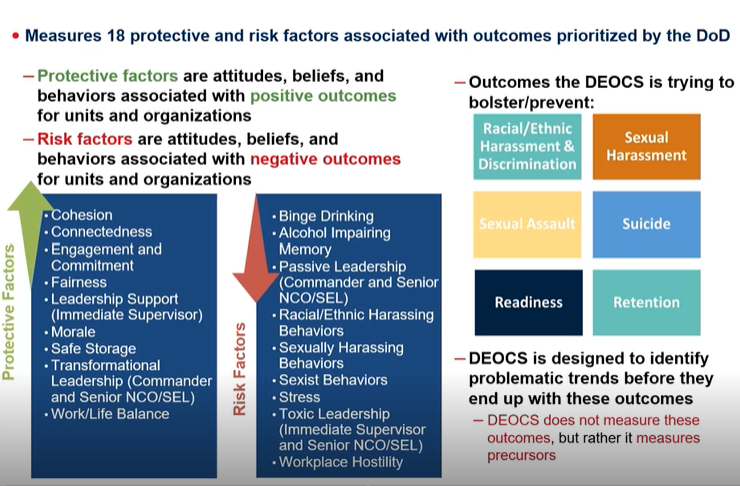
The DEOCS is a congressionally mandated, unit-level climate survey that provides commanders with unit-specific information on critical personnel topics. INNG IPPW is responsible for implementing the DEOCS and incorporating the results along with multiple other data sources into the state comprehensive IPP plan (CIPP).
TAG has directed that the annual DEOCS will now be conducted every two years (see attachment Tab F in FRAGORD 04 to JOPORD 25-01) with the next survey window being 01 August – 30 November 2026. This allows more time in between survey cycles for units to implement Command Action Plan (CAP) items.
This also allows the IPPW (J9 Prevention staff) to better support the individual units’ needs, such as conducting more Sensing Sessions (focus groups) and in-depth records reviews (analysis of frequency of awards, promotions, disciplinary actions, retention trends, etc., no PII required).
Please reach out to sign up for a Sensing Session.
Visit the Defense Command Climate Portal Survey Resource Center: